Showing posts with label Confessing Reader. Show all posts

Monday, May 02, 2011

Granger: The Publication of the King James Bible

"At the Hampton Court Conference of 1604, held between the English bishops and Puritan leaders and presided over by King James the First, Dr John Rainolds, President of Corpus Christi College, Oxford and the leading Puritan divine, suggested that a new English translation of the Bible be prepared.  Richard Bancroft, the Bishop of London, concurred, and King James ordered the translation be prepared.  A body of translators was formed, including professors of Hebrew and Greek in the universities of Oxford and Cambridge and other leading scholars of the day, some fifty in all. Both churchmen and Puritans were represented. The translators were organized into six companies, two which sat at Oxford, two at Cambridge, and two at Westminster. Their instructions were to take the earlier Bishops’ Bible as their basis, to consult all earlier versions, including the (Roman Catholic) Douay-Rheims New Testament and the (Reformed) Geneva Bible, to retain the old ecclesiastical terms (such as “church” for “congregation” and “baptism” for “washing”), and to exclude all marginal notes, unless required to explain some Hebrew or Greek word...."

Read it all here at For All the Saints.

And for more about the Kings James Bible as English-speaking Christians around the world celebrate its 400 years, see the the fine King James Bible Trust web site.

Saturday, February 19, 2011

This Blog's Sidebar

It's been some time since I've updated the Blogs for Faithful Churchmen blog roll on the right column here, so I thought I'd draw attention to my addition of one blog and my deletion of two others.

New is For All the Saints, though perhaps it would better be described as a "renewal" or even "resurrection," albeit in a slightly different guise. This For All the Saints blog (not to be confused with the Lutheran breviary [daily prayer books] For All the Saints) -- subtitled "encouraged by their examples, aided by their prayers, strengthened by their fellowship" -- is a new effort by an old blogosphere "friend," Todd Granger. In starting it last November 28, he wrote:
One of the features of my near-defunct weblog, The Confessing Reader, was the posting of the commemorations of the saints in the sanctoral (saints’ days) calendars of the Churches of the Anglican Communion, along with some commemorations from the Lutheran Book of Worship.

This weblog will continue that function of The Confessing Reader. For each commemoration, or “lesser feast” as The Episcopal Church’s sanctoral supplement to the Book of Common Prayer described them, I will post a brief biographical sketch, the collect for the commemoration, and the propers for the day (or a link to the Lectionary Page’s propers for the day). For most of the posts, there will also be an icon, or an iconographic depiction, of the saint whom we are commemorating and for whom we are giving thanks that day.
Read more of his (re-) introduction here.

The Confessing Reader itself has been on my blog roll for as long as I've had one, but (as Todd notes) it is nearly defunct. In its heyday it not only featured the calendar of saints, but regular theological reflection on current matters (including the controversies within the Episcopal Church, most of which were quickly immersing the ELCA) and news from the Nordic (Lutheran) churches -- something notoriously difficult to find in English. Now, there's still plenty of good things in The Confessing Reader's Word Press archives (though much more got lost in the fall of CANNet), but apart from occasional posts of the calendar of the saints, which is now on Todd's newer blog, it's been pretty quiet the last couple of years.

Pontifications has also been on my blog roll forever, another must-read CANNet-hosted blog written by Fr. Alvin Kimel, started when he was a reasserter Episcopal priest. What one finds on the current Word Press iteration is but a shadow of the wonderful reflections and discussions that were lost (at least to the blogosphere) in CANNet's fall. Fr. Kimel's blog quieted down when he gave up the struggles of being faithful in the Episcopal Church and was received into the Roman Catholic Church and ordained a priest under the Pastoral Provision. He is, I suspect, much more content -- at least that's what I read between the lines of a blog whose last post was a year-and-a-half ago.

Friday, February 26, 2010

The Seven Marks Society: Vision Statement

Late in the evening of Wednesday, 30 September 2009, after Compline at the General Retreat of the Society of the Holy Trinity, nearly three dozen pastors (members and non-members of the Society) gathered together to discuss a common response to the actions of the previous month's ELCA Churchwide Assembly and Lutheran CORE's recasting itself as a movement for the renewal of Lutheranism in North America.

By midnight, we'd established both Yahoo! and Facebook groups, and within a week some 75 pastors had signed on to form what was soon called the Seven Marks Society — referring to Luther's seven Marks of the Church that had been the focus of the STS General Retreats 2007-2009. We planned to constitute the Society at a convocation in Nashville on 29-30 January 2010, but icy weather conditions caused its postponement to a later, yet undetermined, date.

The Seven Marks Society is being launched nonetheless, and the Chairman of its initial Steering Committee has shared his

Vision Statement


The Rev. Dr. Timothy D. Hubert
January 30, 2010


Grace and peace to you, from God, our Father, and the Lord, Jesus Christ. Amen.

Is it only pure nostalgia that brings us together tonight? Is it the looking backwards with our rose colored glasses, remembering a time when, we believe, the churches we belonged to, though different, all acted more alike than the single church we belong to now acts through its unity in diversity culture?

Do we really remember a time when the behavior of pastors and congregations were noted and carried consequences? Do we really remember a time when divorcing pastors were summarily removed from their congregations? Do we remember a time when a congregation would likely be removed for going their own way?

Do we remember when clergy enjoyed meeting together, learning from each other, helping each other in our parish ministries? Do we remember when clergy spouses called each other friend?

Do we remember when the church’s publishing house actually produced a faithful and usable catechism curriculum? (A few years ago, a popular, and expensive, catechism program denied real presence when it taught about Holy Communion.)

But, of course, the reality is that the seeds for the ecclesial discontent were planted fifty or more years ago. I remember a tract, (Do you remember tracts that we used to put in the narthex for visitors and members)? This was back in the days when I was in the Augustana Synod, yes, that paragon of virtue and faithfulness that I never tire of publically remembering. About 1958 a tract was published by Augustana that tried to explain the Holy Trinity. On the face page was a pleasant graphic. Page two talked about God the Father. Page three talked about God the Son. And page four was blank.

We gather today because we and the churches we serve have become confused, disoriented and depressed. Today we are energized by potlucks, by doing things our own way and by doing mission locally, but not evangelically. Deep down we know something is wrong.

Today we are frightened whenever anyone talks about congregations working together. We are terrified that someone will ask us to go the extra mile, to actually be evangelical (so that our name accuses us), to be Christ’s presence in the market place. We are terrified because we have no models, no resources, not even a clue on where to begin.

This is where those of us who call ourselves evangelical catholic Lutherans are encouraged to jump in with both feet. But, let’s get something straight. We are not individuals, nor even individual congregations. We are the people of God! You are my spiritual flesh and spiritual bone and I am yours! Your faithfulness in ministry is my faithfulness and mine is yours! Your frustrations, fractures and fumbles are mine and mine are yours.

We are the Seven Marks! Word and Sacrament gather us together in the mission and ministry of the church. We are not gathered because it is fashionable or because this is our support network or because it makes us feel good. It is Word and Sacrament that gathers us. It is Jesus Christ who gathers us together. It is Jesus Christ, in Word and Sacrament, who gathers us to be His body, to do His mission through the ministry of His church.

This mission and ministry is guided by bishops and pastors and lay leaders. Christ Jesus instituted the holy office of ministry and we call to serve those who love Jesus, are well trained and equipped with spiritual and practical gifts for ministry. This is an honorable office because it is Christ’s office.

The office of pastor is not an afterthought. It isn’t an embarrassing necessity. It isn’t occupied by hirelings who neither care for nor love the sheep of that particular fold. It can’t be filled on the spur of the moment even by people whose only credential is good will. The office of pastor is occupied to those who will show us heaven, who will encourage us to come closer to our heavenly Father, who will point to the signs of the Holy Spirit in our midst.

The office of pastor is occupied by those who will point us to the holy and life giving cross, who will lead us in sacrificial service, who will champion the poor among us. It is the role of the pastor to remind us that justice is doxology, not the touch stone of our confession.

Is this pure nostalgia? Is this idealistic nonsense? Or is this the goal, the vision, for faithful ministry among us? Do we gather here tonight because we are theological fossils or because we are living vessels holding tightly to a precious and holy treasure?

Did we come all these miles and spend our own money in order to indulge our common delusion of a bygone and largely forgotten era? Or have we been called by a living God to remember how His Church was formed and spread around the entire world? Are we not the spiritual descendants of the Petrine epistles (a la Ray Brown)?

How can we give this up? How can we turn our back on our faithful ancestors? How can we say no to Jesus, who gathers us in and through the seven marks of His church?

In a culture that emphasizes the individual, as if happiness can only come when we are true, Socratic-ally, to our own selves, do we dare to be silent? In a culture that champions democracy over faithfulness, do we dare to be silent? In a culture that calls evil good and good evil, do we dare to be silent? In a church that can’t separate philosophy from the faith, do we dare to be silent?

No! Our presence here tonight is not silent. We are here because we are faithful bishops, pastors and laity. We are here because we are held captive to the Word of God. We are here because there is nowhere else to go.

We are here to live out a full and faithful church life, where we counter the cultural pull and live out the seven marks. We are here to begin an evangelical outreach, celebrating our Petrine catholicity, carrying our vision into the public market place. We are both faithful and accountable. We do mission for mission’s sake. We love sacrificially. We help each other, because, to be faithful we can do no other!

This Society exists because the Lutheran churches need us. This Society exists because Lutherans around the world want to know there is someone they can talk to in this country, who understands their concerns, who shares in their vision of ministry.

This Society exists to be a light in the wilderness, to produce faithful and confessional programs and materials and maybe even tracts with all three persons of the Holy Trinity. We are being challenged to produce faithful, scriptural, traditional materials for youth groups, women’s groups, men’s groups, councils, evangelism committees, parish councils, stewardship committees, Sunday Schools. We are being challenged to provide solid training in forming lay leadership. This Society exists to help in the formation of bishops, pastors and deacons.

This Society is meant to be a missional home for those of us who have nowhere else to turn, to help congregations in many different Lutheran and Christian church bodies to be faithful to the Great Tradition in which we were born.

May God, the Father, +Son and Holy Spirit bless us and be a blessing through us! Amen.

Sunday, December 09, 2007

CaNNet Update

Both Drell's Descants (on his new back-up site) and, now TitusOneNine report the major hacking of CaNNet over the (U. S.) Thanksgiving Day weekend, and The Elves at T19 report:
Mike Daley of CaNNet is still working to restore the blog databases and partitions, and hopes to have the blogs backup as soon as possible, perhaps within a few days.
and offer links for a handful of CaNNet bloggers who've created alternate sites.

Pastor Zip prays for Mr. Daley's success, for not only has CaNNet been a fine vehicle for bringing orthodox Anglicans in North America together, it has been a wonderful resource of theological comment on the crises in the Episcopal Church and Anglican Church in Canada as the ELCA and ELCIC rush down the same tracks of letting our life experience judge the Holy Scriptures rather than the other way around.

Saturday, December 01, 2007

The Confessing Reader Creates Back-Up

The Confessing Reader, one of my favorite blogs and one featured in my "Blogs for Faithful Churchmen," has established a back-up blog. He'll be posting there while server problems keep CANNet out of commission.

Why is this a worthwhile blog? Written by an Anglican/Episcopal layman by the name of Todd Granger, The Confessing Reader's special gift is highlighting the Sanctoral Calendar -- that is, the festivals of the Church, as observed (for the most part) in the Episcopal Church. The current entry, for example, is about Nicholas Ferrar, a Deacon in the Church of England whose heavenly birthday is 2 December 1637. Todd has a brief biography, the Collect for the day, and references to the propers (readings, etc.) for worship or devotions.

In addition to very serious theological commentary from an orthodox Anglican perspective (yes, laymen can do that -- and very well, too), The Confessing Reader (that's a link to the long-established site, in the expectation that it will rise again) is also one of very few sources for English-language news of what is happening within the (Lutheran) Churches in the Nordic and Baltic lands. (The other one is Touchstone magazine.) I'm not quite sure how that came to be, but as one with roots in the Swedish Church I'm glad he's been doing that.

With good fortune, all that has been posted on The Confessing Reader these years will soon be recovered. And until then, we have its new back-up available. Tip o' the biretta to The Confessing Reader himself!

What Happened to CaNNet? (with update)

The blogs at classicalanglican.net -- including the excellent Confessing Reader and many other that have been a key part of the faithful voice within the Episcopal Church and the Anglican Church in Canada -- have disappeared. My WHOIS domain search has the domain expiring tomorrow, but that doesn't explain why the network is no longer accessible. Perhaps traffic crashed the system? Anyone heard anything?

* * * * * * * *

UPDATE: A CaNNet blogger tells me that it "suffered a major attack last weekend" and its Webverger is busy trying to reconstruct things.

I'll note that this is not the first time this has happened with CaNNet, or with other systems -- I've heard what webmasters of 70th Infantry Divison Association and ALPB Forum Online have had to deal with. Between spammers and others always trolling around, it's actually quite amazing that blogs, regular websites, or -- for that matter -- the entire Internet are as stable as they are.

Prayers for Mr. Daley's success. And for everybody else's patience.
                   spt+ at 6:15 PM

Wednesday, March 28, 2007

Just a Parish Pastor in Peoria

Granted, a blogger can't be a complete shrinking violet. Nevertheless, when I wrote about the "discovery" of "Jesus' tomb", while I thought it qualified as a genuine pithy comment, I really didn't expect The Confessing Reader to write this:
As for His Body: here it is

Pastor Zip on the nonsense of James Cameron’s claims about Jesus’ tomb and his bones being found.

Bar none, it is the best response I’ve seen. Talk about bringing such claimants as Cameron and his co-author up short.
It's not helpful for one's Lenten discipline.

But thank you, Todd.

Wednesday, October 04, 2006

"Creator noster"

or One Word Really Does Make a Difference

The Confessing Reader has picked up on my prior entry, calling the prayer suggested for LWF Sunday "a parody of the Our Father." (Creator Noster is his blog-entry title, "because it is neither the Pater noster nor the Lord’s Prayer.")
The Lord’s Prayer, or the Our Father, has from time to time suffered this sort of parodying, most such parodies directed at removing the offensive “Father” in the prayer’s address. If there be any truth at all in the dictum lex ordandi lex credendi, then it is particularly egregious that the Our Father, given to the Church by the Lord Jesus himself and in liturgical use by Christians probably since the time that the Gospel According to Matthew was written or redacted (given the addition of the concluding doxology that is not present in the Lucan text) and at least since the time that the Didache was written (which enjoins on Christians the thrice-daily recitation of the Lord’s Prayer as a sort of embryonic daily office), has been so subjected.

As for this particular parody, there are elements that are essentially noncontroversial. Who indeed could disagree with praying God to grant us “courage to denounce what is wrong” or to “encourage us by[his] Word”? Who would dispute the assertion that “many needy people are seeking justice, truth and freedom”?

But this parody distorts, both by commission and omission, the meaning of the Lord’s Prayer. In the place of Jesus’ invitation to his disciples to share the filial relationship he has with God the Father in prayer, the parody would have us pray to a more distant - if loving - Creator. The parody also asserts the same modalistic heresy that such faux-triniatarian ascriptions as “Creator, Redeemer, Sustainer” make, in limiting the creative power of God only to the Father, while the holy Scriptures and holy Tradition ascribe creation to the Father, to the Son, and to the Holy Spirit.

Go ahead, read the whole thing here, as Todd Granger offers critiques that I hadn't thought of -- because I saw no need to go past "Our Creator" in the first place. (Sometimes I can be short-sighted.)

He was praying in a certain place, and when he ceased, one of his disciples said to him, "Lord, teach us to pray, as John taught his disciples."

And he said to them, "When you pray, say: "Father, hallowed be thy name. Thy kingdom come. Give us each day our daily bread; and forgive us our sins, for we ourselves forgive every one who is indebted to us; and lead us not into temptation."

Whereupon that disciple said, "Oh my, this will not do. Is there someone who can teach us better?"

And a scribe called Ishmael replied, "Here is a prayer a group of my students crafted...."


(With apologies to the dear and glorious physician, St. Luke the Evangelist.)

Saturday, September 30, 2006

The Angels


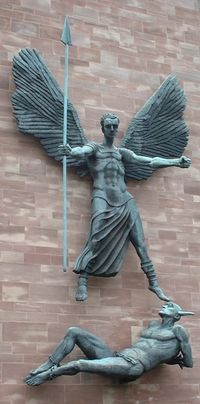
The day that has just past was the festival of St. Michael and All Angels (aka Michaelmas). We celebrated the festival a day early at the closing Eucharist for the STS General Retreat, where Pr. Pari Bailey, STS, preached about the place angels in our culture and in the Christian Faith. I will soon post a copy of that sermon on the STS website, but until then I suggest that you check out The Confessing Reader where you will find -- as you will for nearly every Christian festival that included in the Calendar of the Book of Common Prayer -- a good and faithful description of angels in the Holy Scriptures and Christian tradition.

As the depiction here (taken shamelessly from The Confessing Reader's blog entry) of St. Michael suggests, the angels of God are not the harmless, cute beings in the "angels" section of gift shops, on greeting cards, or in popular American culture. I daresay that images of angels you might find in your local "Christian" bookstore or in a church's children's pageant won't be in line with this photo, either. But ponder upon the first words so often spoken by an angel in the Bible: "Do not be afraid."