Showing posts with label Swedish Church. Show all posts

Friday, March 25, 2016

Sing, My Tongue, the Glorious Battle

A Good Friday hymn that continues to grow on me is the ancient Latin hymn Pange lingua, parts of which appear as two different hymns in the Lutheran Book of Worship: Praise the Savior, Now and Ever, an English translation of the Swedish translation (Upp, min tunga, which I learned in the Vadstena Abbey Church through the Society of St. Birgitta) of the Latin, and Sing, My Tongue, in a translation credited in the LBW to "John Mason Neale, alt." Our friend "alt." has apparently worked considerably on Father Neale's original translation, beginning with Fr. Percy Dearmer over 100 years ago.

The original Latin hymn is by the 6th-century Latin poet (and Bishop of Portiers) Venantius Fortunatus. Here's an English translation of the full hymn (we sing five stanzas in LBW, immediately after the Cross is brought in procession to the front of the Church), by Dearmer and Neale:
Sing, my tongue, the glorious battle,
Sing the ending of the fray;
Now above the cross, the trophy,
Sound the loud triumphant lay:
Tell how Christ the world’s Redeemer,
As a victim won the day.

He, our maker, deeply grieving
That the first made Adam fell,
When he ate the fruit forbidden
Whose reward was death and hell,
Marked e’en then this tree the ruin
Of the first tree to dispel.

Tell how, when at length the fullness,
Of th’appointed time was come,
Christ, the Word, was born of woman,
Left for us His heavenly home;
Showed us human life made perfect,
Shone as light amid the gloom.

Lo! He lies an Infant weeping,
Where the narrow manger stands,
While the mother-maid His members
Wraps in mean and lowly bands,
And the swaddling clothes is winding
Round His helpless feet and hands.

Thus, with thirty years accomplished,
Went He forth from Nazareth,
Destined, dedicated, willing,
Wrought His work, and met His death.
Like a lamb He humbly yielded
On the cross His dying breath.

There the nails and spears He suffers,
Vinegar, and gall, and reed;
From His sacred body piercèd
Blood and water both proceed;
Precious flood, which all creation
From the stain of sin hath freed.

Faithful cross, thou sign of triumph,
Now for us the noblest tree,
None in foliage, none in blossom,
None in fruit thy peer may be;
Symbol of the world’s redemption,
For the weight that hung on thee!

Bend thy boughs, O tree of glory!
Thy relaxing sinews bend;
For awhile the ancient rigor
That thy birth bestowed, suspend;
And the King of heavenly beauty
On thy bosom gently tend!

Thou alone wast counted worthy
This world’s ransom to sustain,
That a shipwrecked race forever
Might a port of refuge gain,
With the sacred blood anointed
Of the Lamb of sinners slain.

To the Trinity be glory
Everlasting, as is meet:
Equal to the Father, equal
To the Son, and Paraclete:
God the Three in One, whose praises
All created things repeat.

Wednesday, August 15, 2012

The Feast of St. Mary, Mother of God

August 15 is the Christian Festival day commemorating the Blessed Virgin Mary, the Mother of our Lord Jesus Christ -- and thus properly called, as the Council of Ephesus (in 431) and the Council of Chalcedon (in 451) taught (and the Formula of Concord [1580] affirms), "Mother of God." This morning one of my friends, a priest in the Swedish Church, posted on his Facebook page the following prayer from the Swedish (Lutheran) Reformer, Olavus Petri:
O rena moder Maria, det är dig väl att du har funnit en sådan stor nåd i Gud, att Han i sin stora barmhärtighet och godhet ville utvälja dig att bli hans moder, skänka dig större nåd än till någon annan människa, lovad och ärad vare Hans eviga barmhärtighet och godhet, och välsignad är du, mot vilken han ville vara så nådig.
Google Translate renders it thus (with a couple of adjustments that I think make it more accuriate):
O pure Mother Mary, it is well with you that you have found such a great grace of God, that He in His great mercy and goodness would select you to be His mother, give you more grace than any other person, blessed and honored be His eternal mercy and kindness, and blessed are you, towards whom He would be so gracious.
While there certainly could be a more elegant English translation (perhaps someone knows of one), even here one sees a lovely prayer, no? Thank you, Father Fredrik Norberg.

Over at the For All the Saints blog, Todd Granger reproduces much of a brief essay on St. Mary from Philip Pfatteicher's book, The New Book of Festivals and Commemorations: A Proposed Common Calendar of Saints, where I was struck by the sentence that read,
More is known about her that about most of the apostles.
It is worth reading the entire essay here.

Friday, December 04, 2009

Conference Re-scheduled

The Conference on The 50th Anniversary of The Hammer of God that I posted last month has been rescheduled. It will now be held on Tuesday, 14 September 2010 -- one week later than previously announced. All other details are the same. Click here for the corrected announcement.

Wednesday, November 18, 2009

Baltic Lutheran Bishops Send Message

MESSAGE FROM THE MEETING OF THE BALTIC LUTHERAN BISHOPS

The leaders of the Evangelical Lutheran Church of Estonia, Evangelical Lutheran Church of Latvia and Evangelical Lutheran Church of Lithuania met in Tallinn on the 3rd and 4th of November, 2009 to strengthen the long experience of unity of the Lutheran churches in the Baltic countries and to pray for the fellowship among Christians of the whole world, recognizing that in our time the ties among and within Christian communities in many places are put to the test. Bishops also discussed tasks and responsibilities of their churches looking for better ways of co-operation in the future. Christian faith means living with Christ and serving one another.

Especially at times of the economic difficulties when so many people have lost their external foothold and inner peace, we invite our compatriots to expand their appreciation of their Christian roots and to utilize all the spiritual wealth that is revealed in the Holy Scripture and offered to everyone who turns to God and puts their trust on Christ. The present crisis in the world economy is a fruit of a long term failure to act accordingly the principles which God has laid in the foundations of His creation. Consumerism and individualism of the modern society have taken their toll. To look for solution only by means of mending economy would mean to repeat the same mistake. A spiritual renewal must come first, a renewed sense of balance between rights and obligations, communion empathy, solidarity, and mutual support. We believe that the most convincing inner motivation for that change is found in an encounter of a person with the living Christ. To facilitate that encounter by word and deed is the first and foremost calling of the Christian church. Jesus Christ said: “Go and make disciples of all the nations, baptizing them in the name of the Father and of the Son and of the Holy Spirit, teaching them to observe all things that I have commanded you.” (Matt.28:19-20)

The Christian community as a part of the society is not separated from issues related to the natural and human environment both locally and globally. Justice in the society and life quality of the people or protection of our Baltic Sea against the state negligence and corporate exploitation are some of the critical examples of this area of concern. As communities gathered around the Word of God and the keepers of Christian ethos our churches must address the spiritual root-causes of the contemporary problems. The churches must remember that the main instrument entrusted to them by God is His word – the law and the gospel - and the service to the neighbour in charity.

We also invite our political powers to realize more clearly the spiritual dimension of the human life and the good fruits of a positive co-operation between state, municipalities, schools and the church. Teaching and implementing Christian principles strenghthen the family as well as the whole community. Liberty of conscience and freedom of speech belong to the values of society defining religious life not only as a private but also as a public social right which has to be fostered. Religious education and religious studies form an inseparable part of this right.

At the present time a common witness of churches is vitally important, therefore we express our deepest concern about modern tendencies that weaken the fellowship among Christians and cause divisions in and among churches. The recent decisions made by some member churches of the Lutheran World Federation to approve of religious matrimony for couples of the same gender and to equate such conjugal life with marriage or to ordain non celibate homosexual persons for pastoral or episcopal office epitomize these tendencies that are tearing apart fellowhip among Christians. We affirm that the marriage is the conjugal life between a man and a woman and that a homosexual activity is incompatible with the discipleship of Christ. We believe that in following the modern trends, churches are departing from the apostolic doctrine of human sexuality and marriage. We see the Lutheran communion and eccumenical efforts endangered by such decisions and actions because they lead to a situation where the Lutheran churches, members of the Lutheran World Federation are not able to fully recognize each others ecclesiastical offices, to exchange the ministries and to participate together in preaching the Word and celebrating the sacraments.

We call upon our Lutheran sisters and brothers to unity and co-operation based upon the foundation of Holy Scripture and loyalty to the Lutheran confessions. Contemporary challenges demand a firm stand based upon timeless truths and values. The common understanding of the Gospel by churches is a treasure we cannot afford to lose and it needs to be passed on to the current and future generations. Our mission is to be faithful in that which we have received, God’s mercy. We are to serve our Lord and our neighbours thus until we all reach unity in the faith and in the knowledge of the Son of God (Eph. 4:13)

Archbishop of Riga Janis Vanags
Evangelical Lutheran Church of Latvia

Bishop of Daugavpils Einars Alpe
Evangelical Lutheran Church of Latvia

Bishop of Liepaja Pavils Bruvers
Evangelical Lutheran Church of Latvia

Bishop Mindaugas Sabutis
Evangelical Lutheran Church of Lithuania

Archbishop Andres Põder
Estonian Evangelical Lutheran Church

Archbishop emeritus Kuno Pajula
Estonian Evangelical Lutheran Church

Bishop Einar Soone
Estonian Evangelical Lutheran Church

Tuesday, November 03, 2009

Conference: The Hammer of God

The International Giertz Society
(English Language Section)
& the Pittsburgh Pastoral Conference honor…

THE 50th ANNIVERSARY OF
THE HAMMER OF GOD

with two lectures on Bo Giertz’s beloved and influential novel, which appeared in English for the first time in 1960


The Rev. Hans O. Andræ on “Tyranny and the Gospel: Freedom from Temporal and Spiritual Bondage in The Hammer of God”
Pastor H. Andræ translated the final chapter of The Hammer of God for the 2005 edition, for which he also provided a historical and biographical introduction. While a pastor in Sweden, Andræ worked with Bishop Giertz in Kyrklig Samling. He was a parish pastor in the U.S.A. 1979-2007. His translation of Giertz’s first book, Christ’s Church (Kristi Kyrka, 1939), is expected to be published in 2010.

The Rev. Eric R. Andræ on “‘The best treatment of the proper distinction of law and gospel in the history of Lutheran theology:’ A Historical and Systematic Overview”
Pastor E. Andræ completed his S.T.M. thesis on Giertz’s use of the ordo salutis in 2003 (Concordia, St. Louis). He has had several essays on Giertz published in journals and books in the U.S. and in his native Sweden, and has translated numerous short pieces, as well as a booklet: Life by Drowning: Enlightenment through Law and Gospel (2008, from Kyrkofromhet). He is the founder and president of the International Giertz Society.

Tuesday, 14 September 2010

9:00 a.m. — Noon Continental Breakfast, Matins (9:30), Lectures (10:00)
Noon — 1:30 p.m. Lunch Break (lunch is not provided)
1:30 — 3:30 Screening of The Hammer of God — the brand-new feature length FILM based on the entire first novella

First Trinity Lutheran Church
535 N. Neville St.
Pittsburgh, Penn. 15213 U.S.A.

There is no cost, but you must register:
412-683-4121 x2     EricAndrae@gmail.com


Note: Life By Drowning is available in pdf format here.

Sunday, September 20, 2009

Requiescat in pace: Bishop Bertil Gärtner

Bishop Bertil Gärtner, who served the Göteborg (Gothenburg) Diocese of the Church of Sweden 1970-1991, died early this morning. He was 84.

I first met Bishop Gärtner in 2004 through the Society of St. Birgitta, whom he served as Fader Visitator (father visitor). This year during the Mass on St. Birgitta's Day (that's where I took the attached photo) he preached. Afterwards and for the next couple of days people kept asking me, "Did you understand any of Bishop Bertil's sermon?"

"Not really," I replied each time, "but I know he preached about Jesus." That word I understood. At that point my questioner would tell me some point or detail from the sermon.

It was a deeply personal sermon, which was unusual for him. Actually, I'd suspected that, for there was a brief moment his voice halted and tears filled his eyes. Turns out that was the moment he spoke of his fears from earlier this year when his leg had to be amputated because of his diabetes. Yet even in that darkness, he was given the strength to trust in his savior, Jesus. A word that was helpful to all of us listening to him, for the faithful who have been so beset upon by the church we serve.

Later at the formal dinner, I shared with him the reactions I was getting from people who wanted me to know what he had preached. He smiled at my answer, and told me the story of refugees from Finland who had come to Sweden during the War. Every Sunday they came to church, even though it was all in Swedish and they spoke Finnish. Finally the priest, while pleased they were worshiping, asked them if they were getting anything out of it not understanding the language. "You preach Jesus," they responded, "and that's all we need." Thank you, Bishop Bertil.

Prior to his election as the immediate successor to Bo Giertz as Bishop of Gothenburg, Gärtner was known as an academic theologian, teaching at Uppsala University and then as Professor of New Testament at Princeton University (1965-1969) -- which meant that conversing with him in English was quite easy. After his retirement in 1991, he continued to be very active in the Swedish Church, particularly as a Bishop for various renewal groups and organizations within the Swedish Church.

He had been with arbetsgemenskapen Kyrklig Förnyelse (aKF or the Church Union, a "high church" renewal group) since its founding in 1959, and served as its chairman for many years. He was unable to attend aKF's Church Days at the end of August, but his written message was delivered and appears on their web site -- which, in reporting his death, also describes (at least as Google translate puts it) exactly what many of my SSB friends are feeling at this moment: "Many of us feel like sheep without a shepherd."

He was also active in Oasrörelsen i Sverige, an independent charismatic renewal group, since its beginnings. In their announcement, Oasrörelsen links to an article he wrote for their latest newsletter, "Vara kvar eller inte?" Google translates that as "to remain or not" and, while it needs a lot of polishing, you can get his answer here.

Do we leave the Swedish Church today? he asks. (Is that hitting home, fellow ELCAers?) Wrestling with that question since at least 1979-80, Bishop Gärtner had opportunity to meet Eastern and Western Patriarchs -- the Russian in Moscow, the Greek (the then Patriarch and the current one) in Constantinople, the Roman in Rome (the then-new Pope John Paul II). And in those conversations, he sought their counsel to this question.

Each Patriarch gave the same answer: remain where God has placed you. And that has been Bishop Bertil's conviction ever since.

The Bishop was active in the Free Synod throughout its existence. And from hospital on Saturday, the day before he was called to his eternal home, came his final post on Bertil bloggar ("Bertil blogs"), where he wonders why people knowing nothing about, or not believing in, the Christian Faith would seek election to next year's Church Synod -- and encourages his readers to vote for nominees from Frimodig kyrka.

A Churchman to the end,

Bertil Gärtner (13 December 1924 – 20 September 2009).

Requiem aeternam dona eis, Domine;
et lux perpetuam luceat eis.
Kyrie eleison.
Christe eleison.
Kyrie eleison

Monday, July 13, 2009

Peace (?) Be with You.

The Episcopal Church is currently meeting in General Convention. You can keep track of what's happening over at TitusOneNine, which is near the top of Pastor Zip's "Blogs for Faithful Churchmen" one the right column of this blog.

The big news there, so far, is that the House of Deputies has approved a resolution that "acknowledges that God has called and may call any individual in the church to any ordained ministry in the Episcopal Church, in accordance with the discernment process set forth in the Constitution and Canons of the church." This resolution essentially overturns a resolution from the last General Convention to not ordain any more practicing gay Bishops. Next it goes to the House of Bishops, who need to approve the resolution for it to officially go into effect. (Here TEC's General Convention is like the US Congress, where both the House of Representatives and the Senate must approve legislation.)

Early this afternoon TitusOneNine posted this message from Bishop John Howe of the Central Florida Diocese, which begins:
We have reached the mid-point, and I want to give you some impressions. This is a remarkably different General Convention than any of the previous six I have attended as a Bishop. I would characterize all the previous Conventions as highly contentious. This one is not. We still have the same recurrent issues ahead of us, but the "conservative" wing is so greatly diminished that its voice is almost irrelevant.

I made that comment to one person who questioned whether I really meant it, "Irrelevant? Don't you mean "hated?" No, there is no sense of animosity here. The conservatives state their position(s) respectfully and they are treated with respect in return. It is just that they are so hugely outnumbered that it doesn't matter.

At the open hearings on the sexuality questions the "progressives" outnumber the "conservatives" somewhere between six and ten to one. I have been proud of the members of the Central Florida deputation entering into the debate, but often they have been nearly the only ones speaking on behalf of a "traditionalist" position. (Some of our folks have been approached and questioned by members of the "Youth Presence" that is here who seem never to have heard a "traditionalist" position articulated previously.)
Read it all here.

I read this not long after getting off the phone with a friend in the Church of Sweden, where we spoke of recent events. After that, and what I've been reading of TEC's Convention, and thinking of my recent attitude towards our Synod and Churchwide Assemblies, I'm thinking maybe I've become a bit too peaceful.

Saturday, July 11, 2009

Bo Harald Giertz, Bishop and Confessor, 1998

12 July, Commemoration of Bo H. Giertz, Bishop and Confessor, 1998

Born August 31, 1905 in an atheistic family, Bo Harald Giertz embraced the faith while studying medicine at the University of Uppsala and switched to theology. Ordained a priest in 1934, Giertz first served in youth work, then as an Associate Pastor (komminister) at Torpa (1938-1949). Largely due to his popular writings, such as The Hammer of God (in Swedish, Stengrunden), Giertz became the Bishop of the Göteborg (Gothenburg) Diocese in the Church of Sweden (1949-1970). This was a shock, due both to his young age (44) and position in the rural Torpa parish, as Swedish Bishops were routinely selected from among Cathedral Deans and University Chairmen of Theology. He was leader of the Confessional movement in Sweden (Kyrklig Samling Kring Bibeln och Bekännelsen [The Church Coalition for Bible and Confession]) and served as vice president of the Lutheran World Federation (1957-1963).

In retirement Giertz translated the entire New Testament and provided commentaries on all its books. He was named the most influential Swedish churchman of the 20th century in a nationwide survey at the close of 1999. In influence and style, and as a Christian apologist, he has been compared favorably to Walter Wangerin, Jr., Dietrich Bonhoeffer, and C.S. Lewis. During 2005 symposia were held in the United States, Canada, and Sweden to mark the centennial of his birth. This year marks the 11th anniversary of his death. Next year marks the 50th anniversary of the publication of Clifford Ansgar Nelson's English translation of The Hammer of God.
"The Church is and exists, first and foremost, in that moment when the bishop as a heavenly instrument stands in his congregation's midst and celebrates the liturgical mysteries, full of joy and light and life. In this way the Church is for these people the shining city on a hill, whose walls are always brilliant with light... Here I understood better than ever the very nature of the Church: she is not an institution for grievances, not a protest organization, nor a device for social improvements or any other "goal"; she is the heavenly joy's sanctuary, in which we enter, filled with overwhelming joy [P. Hendrix]. ...

"[A] truly active church life [consists of] prayer and participation in the Lord's Supper. ...

"To be a Christian [is to be] a person who lives in the Church of Christ with all her overwhelming riches." (Bo Giertz, Kyrkofromhet [Church Piety], 128, 100, 151, translation by Eric R. Andrae; Giertz' quote of Hendrix is from Bilder aus der orhodoxen Kirche im heutigen Russland, Eine Heilige Kirche, 1-3, 1937).

Collect:
Lord and Savior Jesus Christ, Bishop of our souls and bodies, shepherd of your people, we thank you for your servant Bo, who was faithful in the care and nurture of your flock; and we pray that, following his example and the teaching of his holy life, we may by your grace grow into your full stature and your name in which we pray. Amen.

Psalm 84
Ezekiel 34:11-16
Ephesians 3:14-21
John 21:15-17
Tip of the biretta to Pastor Eric R. Andrae, who will gladly tell you about the International Giertz Society. The most detailed English-language source on Bishop Bo Giertz is here. See especially the up-to-date Giertz English-language bibliography.

Among Giertz' books currently available in English translation are
The Hammer of God (published by Augsburg Fortress) and To Live with Christ (Att leva med Kristus), Giertz' classic devotions for each day of the Church Year published last year by Concordia Publishing House. Fortunately for us, translators are working on several of his other writings.

Works available on the web include his classic
Liturgy and Spiritual Awakening, which was originally part of a longer pastoral letter at the beginning of his episcopacy, and the recently published (by the Evangelical Lutheran Church of England and the Lutheran Heritage Foundation) pamphlet Life by Drowning: Enlightenment through Law and Gospel.

Friday, July 10, 2009

Church Coalition on Gay Marriage Proposal

Fr. Yngve Kalin of the Kyrklig samling kring bibeln och bekännelsen (the Church Coalition for the Bible and Confession) within the Church of Sweden has issued a:

Statement on the Proposal for a new Order of Marriage for the Church of Sweden

click title for pdf version,
click here for Swedish pdf version

The Governing Body of the Church of Sweden proposes that the Church of Sweden General Synod should adopt an order of marriage that allows two people of the same sex to contract a marriage in the church. In this way the Church of Sweden will adapt its teaching to the values that constitute the majority view in the Swedish parliament (Riksdagen).

This is actually not surprising. The Church of Sweden is permeated by the same political parties that constitute the parliament. The majority of the members of the Church of Sweden Governing Body have party labels, as have those who are members of the Church of Sweden General Synod, and they usually follow their party lines on decisive issues. Theology has been transformed into an ideology and the church’s own institutions happily provide theological post-constructions to the latest opinions and whims of the world.

For the church, this is devastating. The faith, confession and teaching of the Church of Sweden can never rest on political majorities or on the currently fancy views of the world, but only on the revealed Word of God and on the confessional foundation that over the centuries have been formulated in the confessional documents of the church.

The decision now taken by the Church of Sweden Governing Body shows that those who have power in the Church of Sweden are effectively cutting off the church from its roots. The Church of Sweden will now be transformed into a congregational denomination, whose teaching is formulated by simple majority decisions, and where the Bible is being used arbitrarily or even entirely removed in order to legitimize the decisions taken.

A small denomination in the North now chooses its own way and redefines the teaching about marriage that the universal church has given up until now, supported by God’s good order in creation and which is revealed through the word of the Bible and confirmed by the confession of the church. Those who have power in the Church of Sweden have chosen a dangerous road and they now run the risk of leading her out into complete ecumenical isolation.

The issue has however yet another dimension. For each and every one who wants to stand firm on the foundation of the traditional teaching, the matter is not brought to a head, whether or not the Church of Sweden is still a useful tool for God when His word is reinterpreted and, as the Archbishop of Uppsala recently put it, ”extended” and given an entirely new meaning. I therefore appeal to everyone for perseverance in prayer that the members of the Church of Sweden General Synod may come to their senses. Contact them, write letters to them, appeal to them and exhort them! Write to the Archbishop and to the Bishops!

The next few weeks and months will be crucial in many ways. There are many signs that the current church system is being eroded and is falling apart through a rapid loss of substance. Do we really appreciate that all that we possess and still have, we only have by the grace of God? It is in the power of God to break down and to build up whatever He has planted. God’s possibilities are not exhausted. He will show us what we should do if the situation becomes untenable.

”Watch over the flock to make sure that nobody goes astray from the grace of God and that no bitter root will make shoots and become a devastation that affects many.” (Hebr 12:15)

Hyssna, 16 June 2009
Yngve Kalin, Chairman,
The Church Coalition for the Bible and the Confession.
Translation: Sr Gerd Swensson, Te Deum

The Church Coalition for the Bible and Confession
Chairman: Yngve Kalin, Hålsjövägen 32 , 511 68 Hyssna, Sweden
Tel: +46320-38000 yngve.kalin@kyrkligsamling.se

Friday, May 29, 2009

Well, Not So "Careful"

Following up on Wednesday's entry about the election of Eva Brunne as the next Bishop of Stockholm, the following article from the Church of Sweden website (one of 4 stories currently linking from the church's front page is dated Tuesday:

Med blick för de maktlösa

Eva Brunne är skånskan som alltid sett tro och samhällsengagemang gå hand i hand. I valet av henne har Svenska kyrkan för första gången valt en biskop som lever i partnerskap.

Som homosexuell har Eva Brunne ibland känt sig utsatt och det har gett henne ett engagemang för andra.

- Jag vet vad det är att bli ifrågasatt. Jag är i den lyckliga situationen att jag har makt och jag kan använda den till gagn för dem som ingen makt har, säger Eva Brunne, i dag stiftsprost i Stockholm....
With the help of Google Translate, a translation would be something like this:

With eyes for the powerless

Eva Brunne is a Scanian who always believed faith and citizenship go hand in hand. In selecting her, the Church of Sweden for the first time elected a bishop living in partnership.

As a homosexual Eva Brunne has sometimes felt exposed and it has given her a commitment to others.

"I know what it is to be questioned. I am in the lucky situation that I have power and I can use it for the benefit of those who have no power," says Eva Brunne, now a diocesan dean in Stockholm....
(Apologies to my Swedish speaking friends.)

A sidebar describes the Bishop-elect's marital status as "Lever i ett registrerat och välsignat partnerskap" (Living in a registered and blessed partnership). The Church of Sweden began offering the blessing of gay civil unions in 2007.

Interestingly, a list of related news articles includes the headline, "50 år för prästvigda kvinnor" (50 years for the ordination of women priests). The ordination of women was approved by the Church of Sweden in 1958, with the first ordination in 1960.

In an article headlined Church of Sweden elects lesbian bishop the Religion News Service reports:
The newly-elected Lutheran bishop of Stockholm says that being a lesbian means she wants to stand alongside people who feel powerless.

"I know what it is to be called into question," the Rev. Eva Brunne said in an article on the Web site of the Church of Sweden after her Tuesday (May 26) election. "I am in the lucky situation that I have power and I can use it for the benefit of those who have no power."

Brunne, who is currently the dean of the Stockholm diocese, is the first Church of Sweden bishop to live in a registered homosexual partnership, the Uppsala-headquartered church said, and she is believed to be the first openly lesbian bishop in the world.

Brunne, 55, lives with priest Gunilla Linden in a partnership that has received a church blessing. They have a three-year-old son.

"Once you have been baptized, no one can say you cannot be part of the Church because you are homo-, bi-, or transsexual," the Web site of the French periodical Ttu quoted Brunne as saying.

She clinched the post by 413 votes against 365 votes for Hans Ulfvebrand; she will succeed Bishop Caroline Krook, who is to retire in November....

Wednesday, May 27, 2009

Lesbian Elected Bishop of Stockholm

The Diocese of Stockholm in the (Lutheran) Church of Sweden has elected Eva Brunne as its next Bishop to replace the retiring Caroline Krook. The Swedish church newspaper Kyrkans Tidning reports that the 55-year-old parish priest at the Flemingsberg and Sundbyberg churches lives in a registered partnership and has a 3-year-old son. Sweden's gay news site QX reports that she is the world's first openly lesbian woman elected bishop and that her partner, Gunilla Lindén, is also a Swedish priest.

The Swedish newspaper Dagen, when reporting
Brunne's election on Tuesday
that that she is in a registered partnership, reported Wednesday in a follow up that the Swedish Church "has been careful to give no comment" while gay organizations have been rejoicing over her election.

Saturday, March 21, 2009

Liturgy and Spiritual Awakening

Having recently been given a copy of the old booklet published by the Augustana Book Concern by a brother pastor from the Society of the Holy Trinity (thank you, again, Phil), yesterday I read Bo Giertz' Liturgy and Spiritual Awakening. I had read it before, having downloaded its text from the LCMS website several years ago, but holding the actual booklet (autographed by Bishop Giertz!) in my hands makes for a more satisfying reading experience.

The booklet itself is actually only section of Giertz' first pastoral letter (herdabrev) written soon after his 1949 election as Bishop of Gothenburg. Clifford Ansgar Nelson's translator's introduction tells us,
It is an ancient and treasured custom in the Church of Sweden that when a new bishop is elected in any diocese of the country, he writes a pastoral letter intended in the first place for the ministers of the diocese. This "Herdabrev" is usually a very personal word of encouragement and pastoral counseling which serves to introduce the new bishop to his pastors and people. Sometimes the letter is brief and can be contained in a few printed pages but frequently the letter is long enough so that it becomes a book of considerable size.
Pastor Nelson concludes his introduction with a word that, at least from an American Lutheran perspective, is as amazing today in 2009 as when he wrote it 60 years ago:
It deals with a religious question that is perennial in the church. And it is because the bishop reveals such a profound appreciation of the values of religious awakening and evangelical piety on the one hand, and of the time-honored values of liturgical worship on the other, that this section has been lifted out for translation. We in the American churches will do well to ponder the problem that the bishop discusses in these pages. It is toward an understanding both of liturgy and spiritual awakening that this document is herewith published.
Here we see an attitude towards worship unlike what we've experienced in the "worship wars" between "high church" and "low church" proponents. Interestingly, it is an attitude one finds clearly expressed in Giertz' The Hammer of God and one I experienced when with the Society of St. Birgitta in Vadstena.

Perhaps the following will whet your appetite for Bishop Giertz' important message to the priests of the Diocese of Gothenburg in 1949 and to Christians today:
It is important for us that both awakening and liturgy be given their proper and pristine Christian place in the life of the congregation. Awakening is always needed, not only because the church must always be a missionary church and reach out after those that are on the outside, but also because there is always the need for awakening even among the most faithful members of the church. The church has exactly as many sinners as she has members. The old Adam in each one of us is prone to fall asleep, to make the Christian life a dead routine, to use liturgical form to cloak his self-complacency and impenitence. It is not difficult to fashion a form of religion that suits the ego and allows the old Adam within to become sovereign again. One may go regularly to church and Holy Communion. One may cherish beautiful church music and lovely sanctuaries. One may be honestly convinced that one possesses the correct doctrine and loves the pure preaching of the Word. And at the same time one may be thoroughly obsessed by self-love, complacent with one's self, satisfied with one's own pious accomplishments and totally indifferent to the troubles and burdens of one's fellow men, which are so apparent before one's very eyes. The Holy Spirit always needs to awaken slumbering souls, stir up the dust, push the old Adam against the wall, and blow a new breath of life into the dead bones. Awakening is never superfluous, as long as we are in the flesh.

Liturgy is just as needful. There can be no normal church life without liturgy. Sacraments need form, the order of worship must have some definite pattern. It is possible to live for a short time on improvisations and on forms that are constantly changing and being made over. One may use only free prayers and yet create a new ritual for every worship situation. But the possibilities at soon exhausted. One will have to repeat, and with that the making of rituals is in full swing. I circles where people seek to live without any forms new forms are nevertheless constantly take shape. Favorite songs are used again and again with monotonous regularity, certain prayer expressions are constantly repeated, traditions take form and traditional yearly ceremonies are served. But it would not be wrong to say that the new forms that grow up in this way are usually less attractive and more profane than the ancient liturgy. They contain less of God's Word, they pray and speak without Scriptural direction, they are not so much concerned about expressing the whole content of Scripture, but are satisfied with one thing or another that seems to be especially attractive or popular. The new liturgy that grows in this manner is poorer, less Biblical, and less nourishing to the soul than the discarded ancient order.
Go ahead, read it all here or download it here as a pdf document.

Links updated 21 July 2011

Thursday, February 28, 2008

Swedish Eucharistic Prayer

Here is an English translation of the Eucharistic Prayer used in the Church of Sweden as published on its web site and as I've inserted it in my Altar Book.

Praise be to you, Lord of heaven and earth.

You have revealed your mercy towards your people
in giving your only begotten Son,
that whoever believes in him should not perish,
but have eternal life.

We give thanks for the redemption you have prepared
for us through Jesus Christ.

Let Your Holy Spirit come into our hearts
to enlighten us with a living faith.

Sanctify by your Spirit this bread and wine,
which earth has given and human hands have made.

Here we offer them to you,
that through them we may partake
of the true body and blood of our Lord Jesus Christ.

On the same night in which he was betrayed,
he took bread, gave thanks,
broke it, and gave it to his disciples, saying:
”Take, eat.
This is my body, which is given for you.

Do this in remembrance of me.”

In the same way, he took the cup,
gave thanks, and gave it to his disciples, saying:
”Drink this, all of you.
This is my blood of the new covenant,
which is shed for you and for many
for the forgiveness of sins.

Do this, as often as you drink it,
in remembrance of me.”

Therefore, heavenly Father, we celebrate this supper
in remembrance of your Son's passion and death,
his resurrection and ascension.

We will eat the Bread of Life and drink the Cup of Blessing
until the day when he comes again in glory.

We ask you:
remember the perfect and eternal sacrifice
through which, in Christ,
you have reconciled us with yourself.

Grant that we may be united into one body,
and be made a perfect living sacrifice in Christ.

Through him, and with him, and in him,
by the power of the Holy Spirit,
all glory and honor is yours, almighty Father,
for ever and ever.

Amen.

Thursday, December 13, 2007

Sankta Lucia


Today is St. Lucy's Day. Yes, one more Swedish tradition that didn't make it to my generation in California. Nor did we celebrate it at Saint John's Lutheran Church in Helena, Montana, though there I did get to experience other Advent and Christmas traditions immigrant Swedes brought with them.

The photo above I took from today's Church of Sweden front page. This article is from The Local, Sweden's news in English
The tradition of celebrating Saint Lucia of Italy in Sweden is honoured annually on 13th December. The total darkness of the Lucia early morning is broken by the glow of the Lucia figure dressed in a flowing gown of white and afire with a wreath of candles upon her head. Sankta Lucia, as she is known in Swedish, is a creature of goodness and light. She is a shining angel illuminating the way to the Christmas season.

The Lucia celebration originates from the Middle Ages when December 13th was the longest night of the year according to the Julian calendar. The Swedish Lucia has little in common with her namesake, also known in English as Saint Lucy, the Sicilian 4th century martyr. There is no certainty of the route the tradition took while establishing itself in Sweden.

However, it is popularly associated with a legend of a white-clad maiden, wearing a crown of burning candles. She appeared on the shores of Sweden’s largest lake, Vänern, bringing food to starving villagers during a time of famine. Ever since, she has been associated with light.

Today, the tradition is played out most often in the schools, churches and places of work before the dawn. A lucky girl dressed in a long white gown with a red sash and a crown of candles leads a procession. In tow are similarly dressed girls (tärnor) and boys wearing a tall pointed hat carrying a star wand (stjärngossar).

The rest of the procession is made up of girls and boys in similar dress sing beautifully haunting carols. Once the singing is over, the procession and its observers enjoy coffee and saffron-flavored buns called lussekatter.

Not too long ago the Lucia procession also took place at home. The eldest daughter had the honour to be Lucia. She and her siblings roused the family with their singing. Then the family gathered together with saffron buns at breakfast.

As the work traditions evolved in Sweden and both parents would go off to work dropping off children at centres and schools, there was a natural shift to leave the procession to the various institutions where people gather at the start of their day. Some modern families keep up the practice, but most often only for special guests or grandparents.
Read the rest of the article, first published last year, here. For more on the celebration of St. Lucia in Sweden, see this article by Kristian & Nora or this one by Ingegerd.

Saturday, December 01, 2007

The Confessing Reader Creates Back-Up

The Confessing Reader, one of my favorite blogs and one featured in my "Blogs for Faithful Churchmen," has established a back-up blog. He'll be posting there while server problems keep CANNet out of commission.

Why is this a worthwhile blog? Written by an Anglican/Episcopal layman by the name of Todd Granger, The Confessing Reader's special gift is highlighting the Sanctoral Calendar -- that is, the festivals of the Church, as observed (for the most part) in the Episcopal Church. The current entry, for example, is about Nicholas Ferrar, a Deacon in the Church of England whose heavenly birthday is 2 December 1637. Todd has a brief biography, the Collect for the day, and references to the propers (readings, etc.) for worship or devotions.

In addition to very serious theological commentary from an orthodox Anglican perspective (yes, laymen can do that -- and very well, too), The Confessing Reader (that's a link to the long-established site, in the expectation that it will rise again) is also one of very few sources for English-language news of what is happening within the (Lutheran) Churches in the Nordic and Baltic lands. (The other one is Touchstone magazine.) I'm not quite sure how that came to be, but as one with roots in the Swedish Church I'm glad he's been doing that.

With good fortune, all that has been posted on The Confessing Reader these years will soon be recovered. And until then, we have its new back-up available. Tip o' the biretta to The Confessing Reader himself!

Saturday, November 10, 2007

A Call to Liberate the Church of Sweden

I've been alerted to the latest article by Father Yngve Kalin, priest in the Church of Sweden and Chairman of the Church Coalition for the Bible and Confession (Kyrklig samling kring Bibeln och bekännelsen). It appears as an op-ed in today's Svenska Dagbladet, the main newspaper of Moderaterna (the Moderate Party, a non-socialist party that heads the current coalition government in Sweden) and one of Sweden's leading daily papers.

Father Kalin, who I have posted earlier, has long been exposing the plight of the faithful in the Swedish Church. Here he describes how the "separation of church and state" in Sweden has actually given the Swedish political establishment
more control over the Church. What follows is what appears on Fr. Kalin's website. (Or read it in Swedish here or as it appears on the newspaper's site.) My friend from the Society of St. Birgitta, Dr. Birgitta Peterson, writes, "Read it and please spread it around! Particularly among your Lutheran friends who need to know what happens to the Lutherans in Sweden."

One last note: a colleague suggests that the Swedish words translated here as "consequence" would be better understood as "consistency." spt+

+ + +

The political parties still keep their grip on the Church of Sweden. That is a paradox and an inconsistency of the separation between the church and the state which is deeply embarrassing and a cause of a great deal of surprise abroad. This amounts to political double-dealing, writes the Church of Sweden priest Yngve Kalin, who has long-standing experience as a member of the Church of Sweden General Synod.

Saturday November 10, 2007

Politicians in the Church Amounts to Sheer Parody

The current Swedish government, which is constituted by a political coalition, are seeking to introduce a legislation that would prohibit every aspect of religious education in the curriculum of the schools. Such sentiments show a clear resemblance to the way things work in the USA, where the Constitution lays down the principle that church and state must be kept separate coupled with some clear statements about religious liberty.

In Sweden however, the details of these government proposals are being prepared while the political parties continue unabated to hold a firm grip on the Church of Sweden and unashamedly to make use of the Church in order to promote their own political programmes.

This is a paradox and an inconsistency of the formal separation between the church and the state in the year 2000, which is a cause of embarrassment for the political establishment and a fact that gives rise to considerable surprise abroad. This political double-dealing is a cause of great embarrassment.

For anyone who would stand for a clear separation between the church and the state, such a position requires consequence in every aspect and must be followed all down the line.

It is now high time for the political parties to withdraw and stop acting as attorneys for the church — not only for the sake of the church, but also for the sake of their own credibility.

When the business of the Church of Sweden are debated by its own highest decision-making body, the Church of Sweden General Synod, it is in fact Social Democrats, right wing Moderates and members of the Centre Party, etcetera, etcetera, who meet to take decisions on issues of all kind, ranging from statements of faith and doctrine to everyday humdrum matters, and their decisions permeate every aspect of the work of the Church of Sweden at every level.

The parishes as well as the dioceses and the national level are consequently the object rather than the subject in this altogether unique manner of decision-making that is unheard of in any other part of Christendom. There is no real separation between the church and the state in Sweden. The political parties have made sure of that, mainly due to their innate fear of permitting too many independent players in the public arena. All this is only too obvious, not least in the current debate about possible new legislation about marriage, in which the political agenda increasingly gains the upper hand, making it blatantly obvious how the church is currently being used to legitimize politically based positions and viewpoints.

BUT: What will these statements and expressed positions really be worth, when it is only too obvious to everyone that they only represent a duplication of decisions taken by the party congress? To begin with, things were different: the uniqueness of the church used to be respected.

When the Church of Sweden General Assembly (as it was called until the formal separation of church and state in the year 2000) met for the first time in 1868, following the Abolition of the Parliament of the Four Estates, it consisted of 30 priests, 30 lay members and the bishops were members ex officio. The Church Assembly was charged to express "the common thought of the guarantors of the faith and doctrine and of the parishes" and should lift church matters above "such political differences that always shift within a national assembly."

In those days the awareness prevailed that the manner of making decisions in the church — even in an established church — must consider the responsibility inherent in the stewardship of the tradition of faith, confession and doctrine that had been handed down and received, and that the parishes must be accorded some real influence on the matters of the Church of Sweden and its government. However, the manner of decision-making was gradually changed.

A reform in 1949 changed the constitution of the Church Assembly and put the laity in the majority. The ex officio membership of representatives for the theological faculties was abolished in 1970. The role and influence of theology was markedly weakened.

The next decisive reform took place in 1982, when the Church Assembly became openly political on the model of the parochial church councils that had been developed particularly at the local level in the city parishes.

From then on, elections took place by a system of electors, but the number of members was more than trebled and the party groups appeared openly as nominators and as membership groups. That meant that the politically independent members, who had nevertheless been elected, found it necessary to organise themselves into a politically independent group.

At the same time the bishops were divested of their right to vote in the Church Assembly but were charged with the duty to be present. It was left to the political parties and groupings to take decisions about any possible representation of the clergy on the membership.

When all this had been achieved, a way had been found to continue to exert control while at the same time the out-dated bonds between the church and the state could cease to exist in any formal sense. That decision was taken in 1997. Later on the Church Order, which provides the tools for the domination of the church, was laid down.

Through the introduction of direct elections at all levels, the parties no longer need to take the "long way" via the parishes in order to ensure that their representatives become members of the diocesan governing bodies and what is nowadays called the Church of Sweden General Synod.

The Church of Sweden Church Order no longer recognises any independent responsibility for the ordained ministry. The entire framework for the exercise of ordained ministry has been established with great consequence and the limits have been effectively imposed by politically elected bodies.

The control of the church is now totalitarian and complete. How long can this parody be allowed to continue? Should there be a separation between the church and the state or not? Could we please have at least an ounce of consequence, thank you!

YNGVE KALIN

Priest in Hyssna and a member of the Church of Sweden Church Assembly 1995-2000 and of the Church of Sweden General Synod 2000-2001, currently a member of the Nomination Group "Confident Church" and called upon to serve at the recently held sessions of the Church of Sweden General Synod this autumn.


© Yngve Kalin & Svenska Dagbladet 10 nov 2007

Friday, November 24, 2006

"The Church of Sweden is about to implode."

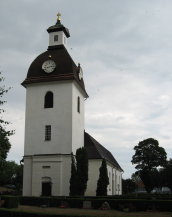
This past summer I visited Sweden for the second time to attend the General Chapter of the Society of St. Birgitta and to explore both my ancestral and churchly roots. (The photo here is one I took of the Kristdala kyrka (Kristdala parish church), where my maternal grandfather's mother and her family and ancestors were baptized and confirmed before they started immigrating circa 1870.)
Because of those connections I have long held an interest in the Church of Sweden, and I have followed the news of her decline particularly in the last couple of generations -- a decline the leaders of the Episcopal Church in the USA and, alas, our own Evangelical Lutheran Church in America seem eager to emulate.

Among the leaders of the faithful in the Swedish Church is Fr. Yngve Kalin, chairman of
Kyrklig samling (The Church Coalition for the Bible and the Confession) and pastor of the Hyssna congregation near Gothenburg in western Sweden. His latest public letter, which has also been published in the journal Svensk Pastoral Tidskrift, was sent to me by my friend Dr. Birgitta Peterson who wrote, "Yngve Kalin would be grateful if you in different ways could help spreading this 'message from Sweden' to fellow Christians in the Church Universal."

A Commission of Inquiry, Please!

Hyssna, Sweden 16th September 2006

Dear Friends,

Many people have seen it and increasing numbers are beginning to discover it: Our church is in the process of fragmentation. We have to speak the truth in order to save what can be saved. The facts speak clearly. Attendance at worship has collapsed in many places (only a few more than 100,000 people constitute the average attendance at the Sunday service in the 1837 parishes that make up the Church of Sweden), parishes are being amalgamated (681 parishes and 212 joint parishes have disappeared in five years) and the members withdraw from church membership in large numbers.

Current prognoses predict that in 15-20 years, the membership will have decreased so much that the current level of work can no longer be maintained. We can see that already. Everyone will be affected. The Church of Sweden is about to implode. Now we must act and speak out. We must point out the reasons and work out plans of action.

The Church Order, copied on the Swedish Law of local self-government, expressing and aiming at uniformity, holds together a rocking and reeling organisation. The church is held together by its outward organisation, providing a structure of national coverage, by its organisation of territorial parishes, by its jointly held property, investment funds and pension commitments, but also by the secular social legislation regulating employment rights and the system of fees collection.

The formally free Church of Sweden did not become really free. The Church-State reform at the turn of the millennium only meant that the principle of democracy took effect at all levels in a way that was hitherto unknown throughout the history of the universal Church. Those responsible for preparing and adopting the Church Order chose to ignore the fact that the Church is, by its very nature, something different from a regular democracy. It is not an association, nor a popular movement, ant it is not a legally imposed authority. The theologically motivated national "folk-church" became the democratic "folk-church" at the turn of the millennium, in which the people, through their elected representatives have the right to make decisions on all matters, including matters relating to the "faith, confession and teaching" of the church. This is the threat against the identity of our church as part of the universal, worldwide Church of Christ. If decisions that are contrary to the revealed faith continue to be taken, the Church of Sweden will become more and more isolated from the rest of Christendom. This provincialism threatens her catholicity. The description, "the Swedish Church" will take on an entirely new meaning, with the emphasis on "Swedish." If that will still be a church in the real sense of the word remains is debatable.

This is the reason why the Church of Sweden is losing ground in all areas. How can a church province that is profoundly uncertain about its profession of faith in the living Lord ever hope to awaken and sustain faith in the hearts of its people? How can a church that undertakes its activities on a foundation of doubt and uncertainty ever hope to encourage people to live their lives by faith in the Risen Lord and to proclaim their faith through their actions?

The foundation of the Church of Sweden, its faith and teaching, is in principle unchangeable at all times, regardless of any majority decisions by the politically constituted General Synod. The proud reference in opening statement of the Church Order, proclaiming that the church "is founded on the Holy Word of God," does not seem to have any real consequence in practice. We cannot pass over the fact that the politically elected General Synod is the teaching authority of the Church of Sweden, wielding unimpaired power and primacy as the interpreter of matters of faith and teaching. The so-called Doctrine Commission is purely cosmetic. It can be voted down by a two-thirds majority of the political General Synod. What the Universal Church has formulated during a long process of handing on the tradition of teaching, by ecumenical councils, by studies of the Holy Scripture under guidance of the Holy Spirit can all be changed by political majority decisions.

In this outward framework, a modern, experimental theology flourishes, which has made a virtue out of its own constructed theological model of a continuous revelation. Someone has put it like this: "The church wrote the Bible, and therefore the church can rewrite the Bible." Now that is plain speaking. The Bible is not the revealed word of God which contains everything we need to know for our salvation, and by which the church stands and falls. The Bible is rather a collection of peopleÂ’s experiences of God, and it should be considered in relation to our own experiences and insights. Now you can no longer declare with St Paul: "I know in whom I believe" (2 Tim. 1:12). The cry is rather: "What is it that I no longer have to believe in?" All this takes place under the cover of the concept of biblical interpretation, which now no longer means to translate the words of the Bible into our own circumstances by penetrating ever deeper into the divine Revelation itself, but rather to seek to find out what you might plausibly consider to be the real message of the Bible, and which is often summarised as its "message of love." That is theology without pastoral action, without any enthusiasm for mission and testimony. That can only serve to impoverish the church and its parishes. We have become a church of questions, but without any answers! A "folk-church" without the folks, because the folks are deserting the church!

If you want to pinpoint this a little further, you could say that this theology, which has lost its faith in the Revealed word, make God unknown to us, and Jesus becomes no more than an interesting person, whom some people might find either interesting and others will resist. That which we call the church is no more than an organisation among others, mission equals propaganda and liturgy is reduced to ceremonies. The Christian life-style becomes no more than ethical action, which can change over time. However, the faith in the revealed Word, and in the Risen and living Christ, present in his Church and in the Gospel, is a life-giving power that recreates and transforms us human beings. Even the hardest of hearts might one day be transformed into hearts of flesh...

In the past, I have been accused of painting a black picture. Never mind. I will not cease to speak what is obvious and what an increasing number of people can feel, right into their bones. The words in the Book of the Apocalypse, 3:17 "You say: How rich I am! What a fortune I have made! I have everything I want" would seem to fit the Church of Sweden only too well. That text in the Bible continues: "In fact, though you do not realise it, you are a pitiful wretch, poor, blind and naked."

It is possible to turn things round. First, however, insight about the real situation is required; an awareness of the crisis, in other words. There are still counter-images and there are places where the profession of the faith in the church as "one, holy, catholic and apostolic" are still proclaimed and expressed, in faith and life. There are people who stand firm in this profession of the faith of the apostles, and who uphold that faith in relation to both doctrinal and ethical issues. They take the view that this faith carries far more weight than the political majorities, who have taken on the role as the teaching authority of the Church of Sweden. It is these people, these groups, which are the future of the Church of Sweden. We must not abandon our church in these difficult circumstances, even though there are serious and skilful attempt to drive us out by administrative measures and ever new decisions. To remain will require sacrifices from many of us, and we will have to find unconventional solutions in order to survive. We will continue to tell the truth about how things really are, and to plead for a "commission of inquiry." A commission that would have the courage to evaluate the consequences of the decisions taken, and that would analyse the causes behind the collapse of customary and popular church attendance and the alienation felt by such large groups of the Swedish population in the face of developments in the parishes. We need to recover our confidence and our courage to profess out faith, and we need to find ways to live an authentic Christian life and to be the Church in a minority situation.

If nothing is done, the ecclesiastical system will collapse. Our role is to remain and firm and assiduously proclaim and keep the apostolic faith. When destruction hits, we must start building again on the old foundation, because "There can be no other foundation than the one already laid: I mean Jesus Christ himself." (1 Cor. 3:11)

Kyrklig samling (The Church Coalition for the Bible and the Confession) wants to continue to play the role as the mouthpiece of the truth. I therefore appeal for support for our work, seeking to be a meeting place for all those in our church who desire that the only guiding principle for the church should be the Bible and the Confessional Documents of the Church of Sweden, as the opening paragraph of our constitution puts it.

MAY THE LORD PROTECT AND KEEP US ALL

Yngve Kalin
Chairman,
The Church Coalition for the Bible and the Confession

Translation: 2006 © Sr Gerd Swensson, Te Deum
2006 © Yngve Kalin

Thursday, September 28, 2006

Swedish Confession Service

In his introduction to The Hammer of God last evening at the General Retreat of the Society of the Holy Trinity, Pastor Ronald Bagnall, STS, described the beginning of the pre-1942 Swedish Mass, which was partially quoted in the book. Here it is, using the texts as translated into English for The Hymnal and Order of Service of 1925 as authorized by the Evangelical Lutheran Augustana Synod:

The priest enters singing:
Holy, Holy, Holy is the Lord of Hosts! The whole earth is full of His glory.

Then he says:
The Lord is in His holy temple; His throne is in heaven. The Lord is nigh unto them that are of an humble and contrite spirit. He heareth the supplications of the penitent and inclineth to their prayers. Let us therefore draw near with boldness unto His throne of grace and confess our sins:

The priest and congregation together say:
Holy and Righteous God, merciful Father, we confess unto Thee that we are by nature sinful and unclean, and that we have sinned against Thee by thought, word, and deed. We have not loved Thee above all things, nor our neighbor as ourselves, and are worthy, therefore, to be cast away from Thy presence, if Thou shouldst judge us according to our sins. But Thou hast promised, O heavenly Father, to receive with tender mercy all penitent sinners who turn unto Thee and with a living faith seek refuge in Thy Fatherly compassion and in the merits of the Saviour, Jesus Christ. Their transgressions Thou wilt not regard, nor impute unto them their sins. Relying upon Thy promise, we confidently beseech Thee to be merciful and gracious unto us and to forgive us all our sins, to the praise and glory of Thy Holy Name.

May the Almighty, Eternal God, in His infinite mercy and for the sake of our Saviour, Jesus Christ, forgive all our sins, and give us grace to amend our lives, and with Him obtain eternal life. Amen.

Then the Kyrie and Gloria in Excelsis are sung...

On Communion Sundays, in place of the "May the Almighty, Eternal God..." sentence above, the following Absolution was pronounced by the priest;

If this be your sincere confession, and if with penitent hearts you earnestly desire the forgiveness of your sins for the sake of Jesus Christ, God, according to His promise, forgiveth you all your sins; and by the authority of God's Word and by the command of our Lord Jesus Christ, I declare unto you that God, through His grace, hath forgiven all your sins; in the Name of God the Father, and the Son, and the Holy Spirit. Amen.

Then the Gloria in Excelsis is sung...