Showing posts with label Kalendar. Show all posts

Sunday, April 01, 2018

Christ Is Risen! Alleluia!

I've posted this Easter sermon from St. John Chrysostom before. It's worth posting (scheduled for local sunrise today) again. Happy Easter!

If any person is devout and loves God,
let him come to this radiant triumphant feast.
If any person is a wise follower,
let him enter into the joy of his Lord, rejoicing.
If any have fasted long
let him now receive refreshment.
If any have labored from the first hour,
let him today receive his just reward.
If any came at the third hour,
let him keep the feast with thankfulness.
If any arrived at the sixth hour,
let him have no misgivings for he shall not be deprived.
If any delayed to the ninth hour,
let him draw near, fearing nothing.
If any have waited even until the eleventh hour,
let him not be alarmed at this tardiness.
For the Lord will accept the last
even as the first.
Therefore, all of you,
enter into the joy of your Lord.
Rich and poor together,
hold high festival.
Diligent and heedless,
honor this day.
Both you who have fasted, and you who did not fast,
rejoice together today.
The table is full;
all of you, feast sumptuously.
The calf is fatted;
let no one go away hungry.
Enjoy the feast of faith;
receive the riches of God's mercy.
Let no one bewail his poverty,
for the fullness of the kingdom is revealed.
Let no one weep for his iniquities,
for forgiveness shines forth from the grave.
Let no one fear death,
for the savior's death has set us free.
He who was held prisoner by death
has annihilated it.
By descending into death,
he made death captive.
He angered it
when it tasted of his flesh.
Isaiah saw this, and he cried:
Death was angered when it encountered you
in the lower regions.
It was angered,
for it was defeated.
It was angered,
for it was mocked.
It was angered,
for it was abolished.
It was angered,
for it was overthrown.
It was angered,
for it was bound in chains.
It received a body
and it met God face to face.
It took earth
and encountered heaven.
It took that which is seen
and fell upon the unseen.
O Death,
where is your sting?
O Grave,
where is your victory?

Christ is risen
and you are overthrown.
Christ is risen
and the devils have fallen.
Christ is risen
and the angels rejoice.
Christ is risen
and life reigns.
Christ is risen
and not one dead remains in the grave.
For Christ, being risen from the dead, is become the first fruits of those who have fallen asleep, and to him be glory and honor, even to eternity.

Thursday, May 25, 2017

Ascension Day Worship

The Ascension of Our Lord commemorates the risen Christ's ascension to heaven. The coronation of Christ the King is celebrated, but so in him is the enthronement of humanity itself. As Saint John Chrysostom (ca. 347-407) declared in a sermon on the Ascension, "Our very nature ... is enthroned today high above all cherubim." Notice how this thought appears in the liturgy, particularly in the both the Collect and Proper Preface historically appointed for this Festival day.
Almighty God, we believe that on this day your only Son, our Redeemer, ascended into heaven.
May we in spirit also ascend to that heavenly home and there forever live.
Through the same Jesus Christ, your Son our Lord.
He lives and reigns with you and the Holy Spirit, one God, now and forever.
Amen.

It is indeed right and salutary that we should at all times and in all place offer thanks and praise to you, O Lord, holy Father, through Christ our Lord; who, after his resurrection, appeared openly to his disciples and, in their sight, was taken up into heaven, that he might make us partakers of his divine nature. And so, with the Church on earth and the hosts of heaven, we praise your name and join their unending hymn...

The Ascension of Our Lord is one of the six principal Festivals of the Church Year celebrating the central events in the life of our Lord Jesus Christ and of his Church&mdashthe other five being the days of Pentecost, the Holy Trinity, Christmass, the Epiphany of Our Lord, and Easter.

Following Saint Luke's account in the Acts of the Apostles, the Ascension of Our Lord falls on the fortieth day of Easter, and thus always on a Thursday. This festival day has been included on the Church's calendar since at least the fourth century.


If you are in the Peoria area, you are welcome to worship the Ascended Lord Jesus with us this evening. In addition to Zion's celebration, I am aware of two other Peoria Lutheran churches, Mt. Calvary (whose pastor is also a PLTS alumnus) and Trinity (both Missouri Synod congregations), that offer worship on the actual Ascension Day. St. Michael's and All Angels Anglican Church in Peoria, which offers Vespers and Holy Communion every Thursday, is also celebrating it. In the Catholic Church, Ascension Day is moved to next Sunday.

Friday, April 14, 2017

Repost: Black Friday

Today is the real Black Friday.


Originally posted here Good Friday 2015.

Friday, April 03, 2015

Black Friday

Today is the real Black Friday.


Wednesday, August 15, 2012

The Feast of St. Mary, Mother of God

August 15 is the Christian Festival day commemorating the Blessed Virgin Mary, the Mother of our Lord Jesus Christ -- and thus properly called, as the Council of Ephesus (in 431) and the Council of Chalcedon (in 451) taught (and the Formula of Concord [1580] affirms), "Mother of God." This morning one of my friends, a priest in the Swedish Church, posted on his Facebook page the following prayer from the Swedish (Lutheran) Reformer, Olavus Petri:
O rena moder Maria, det är dig väl att du har funnit en sådan stor nåd i Gud, att Han i sin stora barmhärtighet och godhet ville utvälja dig att bli hans moder, skänka dig större nåd än till någon annan människa, lovad och ärad vare Hans eviga barmhärtighet och godhet, och välsignad är du, mot vilken han ville vara så nådig.
Google Translate renders it thus (with a couple of adjustments that I think make it more accuriate):
O pure Mother Mary, it is well with you that you have found such a great grace of God, that He in His great mercy and goodness would select you to be His mother, give you more grace than any other person, blessed and honored be His eternal mercy and kindness, and blessed are you, towards whom He would be so gracious.
While there certainly could be a more elegant English translation (perhaps someone knows of one), even here one sees a lovely prayer, no? Thank you, Father Fredrik Norberg.

Over at the For All the Saints blog, Todd Granger reproduces much of a brief essay on St. Mary from Philip Pfatteicher's book, The New Book of Festivals and Commemorations: A Proposed Common Calendar of Saints, where I was struck by the sentence that read,
More is known about her that about most of the apostles.
It is worth reading the entire essay here.

Sunday, April 08, 2012

Halleluja! Kristus är uppstånden!

(That is Swedish for) Alleluia! Christ is risen! Here's a repeat from my blog for Easter 2007, an Easter Sermon from St. John Chrysostom. A blessed, holy day to you all.

Photo: Easter 2011, Zion Evangelical Lutheran Church of Peoria
If any person is devout and loves God,
let him come to this radiant triumphant feast.
If any person is a wise follower,
let him enter into the joy of his Lord, rejoicing.
If any have fasted long
let him now receive refreshment.
If any have labored from the first hour,
let him today receive his just reward.
If any came at the third hour,
let him keep the feast with thankfulness.
If any arrived at the sixth hour,
let him have no misgivings for he shall not be deprived.
If any delayed to the ninth hour,
let him draw near, fearing nothing.
If any have waited even until the eleventh hour,
let him not be alarmed at this tardiness.
For the Lord will accept the last
even as the first.
Therefore, all of you,
enter into the joy of your Lord.
Rich and poor together,
hold high festival.
Diligent and heedless,
honor this day.
Both you who have fasted, and you who did not fast,
rejoice together today.
The table is full;
all of you, feast sumptuously.
The calf is fatted;
let no one go away hungry.
Enjoy the feast of faith;
receive the riches of God's mercy.
Let no one bewail his poverty,
for the fullness of the kingdom is revealed.
Let no one weep for his iniquities,
for forgiveness shines forth from the grave.
Let no one fear death,
for the savior's death has set us free.
He who was held prisoner by death
has annihilated it.
By descending into death,
he made death captive.
He angered it
when it tasted of his flesh.
Isaiah saw this, and he cried:
Death was angered when it encountered you
in the lower regions.
It was angered,
for it was defeated.
It was angered,
for it was mocked.
It was angered,
for it was abolished.
It was angered,
for it was overthrown.
It was angered,
for it was bound in chains.
It received a body
and it met God face to face.
It took earth
and encountered heaven.
It took that which is seen
and fell upon the unseen.
O Death,
where is your sting?
O Grave,
where is your victory?

Christ is risen
and you are overthrown.
Christ is risen
and the devils have fallen.
Christ is risen
and the angels rejoice.
Christ is risen
and life reigns.
Christ is risen
and not one dead remains in the grave.
For Christ, being risen from the dead, is become the first fruits of those who have fallen asleep, and to him be glory and honor, even to eternity.

He is risen indeed! Alleluia!

Saturday, April 07, 2012

Were You There?

Johnny Cash and the Carter Family in 1960.


Hat tip to Canon Kendall Harmon at TitusOneNine

Saturday, March 17, 2012

St. Patrick's Breastplate (The Lorica)

In honor of the Feast of St. Patrick who died this day c. 461, here is Cecil Alexander's translation of his wondrous hymn to the Holy Trinity as sung at the fine traditionalist St. John's Episcopal Church in Detroit. And, yes, St. Patrick's Day is also the day of my birth. Which rather makes this hymn all the more significant to me in so many ways.


I bind unto myself today
    the strong Name of the Trinity,
by invocation of the same,
    the Three in One, and One in Three.

I bind this day to me forever,
    by power of faith, Christ's Incarnation;
his baptism in the Jordan river;
    his death on cross for my salvation;
his bursting from the spiced tomb;
    his riding up the heavenly way;
his coming at the day of doom:
    I bind unto myself today.

I bind unto myself the power
    of the great love of cherubim;
the sweet "Well done" in judgement hour;
    the service of the seraphim;
confessors' faith, apostles' word,
    the patriarchs' prayers, the prophets' scrolls;
all good deeds done unto the Lord,
    and purity of virgin souls.

I bind unto myself today
    the virtues of the starlit heaven,
the glorious sun's life-giving ray,
    the whiteness of the moon at even,
the flashing of the lightning free,
    the whirling wind's tempestuous shocks,
the stable earth, the deep salt sea,
    around the old eternal rocks.

I bind unto myself today
    the power of God to hold and lead,
his eye to watch, his might to stay,
    his ear to hearken to my need;
the wisdom of my God to teach,
    his hand to guide, his shield to ward;
the word of God to give me speech,
    his heavenly host to be my guard.

    Christ be with me, Christ within me,
        Christ behind me, Christ before me,
    Christ beside me, Christ to win me,
        Christ to comfort and restore me,
    Christ beneath me, Christ above me,
        Christ in quiet, Christ in danger,
    Christ in hearts of all that love me,
        Christ in mouth of friend and stranger.

I bind unto myself the Name,
    the strong Name of the Trinity,
by invocation of the same,
    the Three in One, and One in Three.
Of whom all nature hath creation,
    eternal Father, Spirit, Word:
praise to the Lord of my salvation,
    salvation is of Christ the Lord.

Wednesday, February 22, 2012

Pope Benedict XXVI: Ash Wednesday Homily

I had to run to the store for some olive oil this morning before the Ash Wednesday service and, on the way back, Sebastian's radio (Sebastian is my 2002 Golf TDI) was tuned to our local EWTN Radio station, which was airing the Ash Wednesday Mass celebrated by Pope Benedict XVI. As I said to the congregation, not only is this Pope a fine theologian, he can preach.
...I would like to reflect on the liturgical sign of the ashes, a material sign, a natural element that, in the Liturgy, becomes a sacred symbol, so important on this day that marks the start of our Lenten journey. In ancient times, in the Jewish culture, it was common to sprinkle one’s head with ashes as a sign of penance, and to dress in sack-cloth and rags. For us Christians, there is this one moment which has important symbolic and spiritual relevance.

Ashes are the material sign that brings the cosmos into the Liturgy. The most important signs are those of the Sacraments: water, oil, bread and wine, which become true sacramental elements through which we communicate the Grace of Christ who comes among us. The ashes are not a sacramental sign, but they are linked with prayer and the sanctification of the Christian people. Before the ashes are placed on our heads, they are blessed according to two possible formulae: in the first they are called “austere symbols”, in the second, we invoke a blessing directly upon them, referring to the text in the Book of Genesis which can also accompany the imposition of the ashes: “Remember that you are dust and unto dust you shall return”.

Let us reflect for a moment on this passage of Genesis.

It concludes with a judgement made by God after original sin. God curses the serpent who caused man and woman to commit sin. Then He punishes the woman saying she will suffer the pains of giving birth. Then He punishes the man, saying he will suffer the fatigue of labour and He curses the soil saying “accursed be the soil because of you, because of your sin.” The man and woman are not cursed directly as the serpent is, but because of Adam’s sin. Let us reread the account of how God created man from the Earth. “God fashioned man of dust from the soil. Then He breathed into his nostrils, a breath of life. Thus man became a live being. Then God planted a garden in Eden, which is in the East, and there He put the man He had fashioned.” Thus the sign of the ashes recalls the great story of creation which tells us that being human means unifying matter with Divine breath, using the image of dust formed by God and given life by His breath, breathed into the nostrils of the new creature.

In the Genesis account, the symbol of dust takes on a negative connotation because of sin. Before the fall the soil is totally good: through God’s work it is capable of producing “every kind of tree enticing to look at and good to eat.” After the fall and following the divine curse it produces only thorns and brambles and only in exchange for the sweat of man’s brow will it surrender its fruits....
That's what I got to hear (in translation from Italian) about an hour before placing ashes on some 30 foreheads and preaching Ash Wednesday myself. You can (like me) read the rest of it here.

Tuesday, January 03, 2012

Church on Friday? It's the Epiphany!

Celebrate the Revelation
of Jesus Christ to All People!

The Epiphany of Our Lord
(The Festival of the Three Kings)


Friday, January 6, 7:00 pm

Candlelight Cathedral Vespers
and
Holy Communion

Zion Evangelical Lutheran Church of Peoria


1534 S. Easton Avenue (at Hayes), Peoria
1 block west of Jefferson & Western
www.zionpeoria.org
(309) 637-9150


The Epiphany of Our Lord celebrates the manifestation of Christ to the world, recalling the visit of the Magi to the infant Jesus at the Holy Family’s home in Bethlehem. This day begins the concluding season of the Christmass cycle (Advent — Christmass — Epiphany) which focuses on the Incarnation — God becoming human in Jesus.

Next to Easter and Pentecost, Epiphany is the most ancient festival of the Church year, having been observed on January 6 in the Christian East since the third century (or earlier) AD — pre-dating the observance of Christmass by a century. The date was derived from the date of the Resurrection (April 6 according to a calendar used in the eastern Mediterranean), which was also taken to be the date of Jesus’ conception. The theological emphasis of Epiphany was not so much the birth of Christ, but the beginnings of his ministry — that is, his baptism, his first miracle (at Cana), and his revelation as the Savior to all — Jews and Gentiles.

The English word "epiphany" comes from the Greek word
epiphaneia, which means "manifestation" or "appearance" — especially that of a sudden force that rescues an army from defeat. It was the word used when a king or emperor would make an official visit to a city of his realm, particularly to show himself publicly to the people. "Epiphany" is also a word used to describe the moment of revelation, insight, or clarification — the "a-ha!" of sudden understanding.

On the Epiphany of Our Lord we see with the Magi that the Infant Jesus, son of the Blessed Virgin Mary, is God the Son come into the world to reveal himself and rescue all humanity (and creation itself) from our Sin. In recognizing the Lord, we humbly offer our gifts to him — and Jesus offers the gift of himself to us. Join us in worship!

Saturday, December 24, 2011

Celebrate His Birth!

You are invited to join the congregation of
Zion Evangelical Lutheran Church of Peoria
in celebrating

The Nativity of Our Lord


Christmass Eve Service of Carols and Candlelight
with Holy Communion @ 7:00 pm

Christmass Day Communion @ 9:00 am

at
Zion Evangelical Lutheran Church
1534 S. Easton Avenue, Peoria
(at Easton and Hayes, 1 block west of Jefferson and Western)

Phone: (309) 637-9150

The Rev. Steven Paul Tibbetts, STS, Pastor


And in the meantime (or if you cannot join with us or your own congregation), take time to hear the sacred music of the Christmass season on Lutheran Public Radio online.

Sunday, May 15, 2011

Sermon for "Good Shepherd Sunday"

The Early Church Father St. John Chrysostom (c. 349-407), Bishop of Constantinople, was noted for his orthodoxy, his eloquence, and his attacks on Christian laxity in high places. Today, the Fourth Sunday of Easter, is also known as "Good Shepherd Sunday" because the appointed Gospel is from the 10th chapter of St. John, where Jesus teaches that he is the Good Shepherd.
"Truly, truly, I say to you, he who does not enter the sheepfold by the door but climbs in by another way, that man is a thief and a robber; but he who enters by the door is the shepherd of the sheep. To him the gatekeeper opens; the sheep hear his voice, and he calls his own sheep by name and leads them out. When he has brought out all his own, he goes before them, and the sheep follow him, for they know his voice. A stranger they will not follow, but they will flee from him, for they do not know the voice of strangers." This figure Jesus used with them, but they did not understand what he was saying to them. St. John 10:1-6
Bishop John preaches to the Church on the cusp of the 4th and 5th centuries:
Observe the marks of a robber. First, that he does not enter openly. Second, he does not enter according to the Scriptures, for this is, "not by the door."

Here also, Jesus refers to those who had been before and to those who would come after him: antichrist and the false christs, Judas and Theudas [see Acts 5:35-38], and whoever else there have been of the same kind.

And he rightly calls the Scriptures "a door," for they bring us to God and open to us the knowledge of God. They make us his sheep. They guard us and do not let the wolves come in after us.

For Scripture, like some sure door, bars the passage against the heretics, placing us in a state of safety as to all that we desire and not allowing us to wander.

And, if we do not undo Scripture, we shall not easily be conquered by our enemies. By Scripture we can know all, both those who are and those who are not shepherds.

But what does "into the fold" mean? It refers to the sheep and their care. For whoever does not use the Scriptures but "climbs up some other way," that is, who cuts out for himself another and an unusual way, "the same is a thief.". . .

When our Lord further on calls himself the door, we should not be surprised. According to the office that he bears, he is in one place the shepherd, in another the sheep. In that he introduces us to the Father, he is the door; in that he takes care of us, he is the shepherd.
From St. John Chrysostom, "Homilies on the Gospel of John 59:2-3", as found in The Ancient Christian Commentary on Scripture, NT IVa: John 1-10 (p. 338).

Bishop John preaches to the Church on the cusp of the 20th and 21st centuries: "[I]f we do not undo Scripture, we shall not easily be conquered by our enemies. By Scripture we can know all, both those who are and those who are not shepherds." But if we in the Church undo Scripture, . . . hmmm.

Sunday, April 24, 2011

Alleluia, Christ Is Risen!

Christ is risen from the dead! By this time on Easter Day, however, many of his pastors have the energy of someone still dead. So, here's a repeat from my blog for Easter 2007, an Easter Sermon from St. John Chrysostom.

Photo: Easter 2011, Zion Evangelical Lutheran Church of Peoria

If any person is devout and loves God,
let him come to this radiant triumphant feast.

If any person is a wise follower,
let him enter into the joy of his Lord, rejoicing.

If any have fasted long
let him now receive refreshment.

If any have labored from the first hour,
let him today receive his just reward.

If any came at the third hour,
let him keep the feast with thankfulness.

If any arrived at the sixth hour,
let him have no misgivings for he shall not be deprived.

If any delayed to the ninth hour,
let him draw near, fearing nothing.

If any have waited even until the eleventh hour,
let him not be alarmed at this tardiness.

For the Lord will accept the last
even as the first.

Therefore, all of you,
enter into the joy of your Lord.

Rich and poor together,
hold high festival.

Diligent and heedless,
honor this day.

Both you who have fasted, and you who did not fast,
rejoice together today.

The table is full;
all of you, feast sumptuously.

The calf is fatted;
let no one go away hungry.

Enjoy the feast of faith;
receive the riches of God's mercy.

Let no one bewail his poverty,
for the fullness of the kingdom is revealed.

Let no one weep for his iniquities,
for forgiveness shines forth from the grave.

Let no one fear death,
for the savior's death has set us free.

He who was held prisoner by death
has annihilated it.

By descending into death,
he made death captive.

He angered it
when it tasted of his flesh.

Isaiah saw this, and he cried:
Death was angered when it encountered you
in the lower regions.

It was angered,
for it was defeated.

It was angered,
for it was mocked.

It was angered,
for it was abolished.

It was angered,
for it was overthrown.

It was angered,
for it was bound in chains.

It received a body
and it met God face to face.

It took earth
and encountered heaven.

It took that which is seen
and fell upon the unseen.

O Death,
where is your sting?

O Grave,
where is your victory?


Christ is risen
and you are overthrown.

Christ is risen
and the devils have fallen.

Christ is risen
and the angels rejoice.

Christ is risen
and life reigns.

Christ is risen
and not one dead remains in the grave.

For Christ, being risen from the dead, is become the first fruits of those who have fallen asleep, and to him be glory and honor, even to eternity.

Friday, April 22, 2011

Good Friday

Photo: Good Friday 2011, Zion Evangelical Lutheran Church of Peoria

              Who was the guilty?
              Who brought this upon thee?
              Alas,
my treason, Jesus,
              hath undone thee.
              'Twas
I, Lord Jesus,
             
I it was denied thee;
             
I crucified thee.

Johann Heermann, 1585-1647; tr. Robert Bridges, 1844-1930
From the hymn "Ah, Holy Jesus" (Herzliebster Jesu)

Saturday, February 19, 2011

This Blog's Sidebar

It's been some time since I've updated the Blogs for Faithful Churchmen blog roll on the right column here, so I thought I'd draw attention to my addition of one blog and my deletion of two others.

New is For All the Saints, though perhaps it would better be described as a "renewal" or even "resurrection," albeit in a slightly different guise. This For All the Saints blog (not to be confused with the Lutheran breviary [daily prayer books] For All the Saints) -- subtitled "encouraged by their examples, aided by their prayers, strengthened by their fellowship" -- is a new effort by an old blogosphere "friend," Todd Granger. In starting it last November 28, he wrote:
One of the features of my near-defunct weblog, The Confessing Reader, was the posting of the commemorations of the saints in the sanctoral (saints’ days) calendars of the Churches of the Anglican Communion, along with some commemorations from the Lutheran Book of Worship.

This weblog will continue that function of The Confessing Reader. For each commemoration, or “lesser feast” as The Episcopal Church’s sanctoral supplement to the Book of Common Prayer described them, I will post a brief biographical sketch, the collect for the commemoration, and the propers for the day (or a link to the Lectionary Page’s propers for the day). For most of the posts, there will also be an icon, or an iconographic depiction, of the saint whom we are commemorating and for whom we are giving thanks that day.
Read more of his (re-) introduction here.

The Confessing Reader itself has been on my blog roll for as long as I've had one, but (as Todd notes) it is nearly defunct. In its heyday it not only featured the calendar of saints, but regular theological reflection on current matters (including the controversies within the Episcopal Church, most of which were quickly immersing the ELCA) and news from the Nordic (Lutheran) churches -- something notoriously difficult to find in English. Now, there's still plenty of good things in The Confessing Reader's Word Press archives (though much more got lost in the fall of CANNet), but apart from occasional posts of the calendar of the saints, which is now on Todd's newer blog, it's been pretty quiet the last couple of years.

Pontifications has also been on my blog roll forever, another must-read CANNet-hosted blog written by Fr. Alvin Kimel, started when he was a reasserter Episcopal priest. What one finds on the current Word Press iteration is but a shadow of the wonderful reflections and discussions that were lost (at least to the blogosphere) in CANNet's fall. Fr. Kimel's blog quieted down when he gave up the struggles of being faithful in the Episcopal Church and was received into the Roman Catholic Church and ordained a priest under the Pastoral Provision. He is, I suspect, much more content -- at least that's what I read between the lines of a blog whose last post was a year-and-a-half ago.

Sunday, January 02, 2011

Christmass Concludes Thursday: You're Invited!

Celebrate the Revelation
of Jesus Christ to All People!

The Epiphany of Our Lord
(The Festival of the Three Kings)


Thursday, January 6, 7:00 pm
Service of Candlelight
Holy Communion
Zion Evangelical Lutheran Church of Peoria


1534 S. Easton Avenue (at Hayes), Peoria
1 block west of Jefferson & Western
www.zionpeoria.org
(309) 637-9150

An offering will be received for the Prison Mission.


The Epiphany of Our Lord celebrates the manifestation of Christ to the world, recalling the visit of the Magi to the infant Jesus at the Holy Family’s home in Bethlehem. This day begins the concluding season of the Christmass cycle (Advent — Christmass — Epiphany) which focuses on the Incarnation — God becoming human in Jesus.

Next to Easter and Pentecost, Epiphany is the most ancient festival of the Church year, having been observed on January 6 in the Christian East since the third century (or earlier) AD — pre-dating the observance of Christmass by a century. The date was derived from the date of the Resurrection (April 6 according to a calendar used in the eastern Mediterranean), which was also taken to be the date of Jesus’ conception. The theological emphasis of Epiphany was not so much the birth of Christ, but the beginnings of his ministry — that is, his baptism, his first miracle (at Cana), and his revelation as the Savior to all — Jews and Gentiles.

The English word "epiphany" comes from the Greek word
epiphaneia, which means "manifestation" or "appearance" — especially that of a sudden force that rescues an army from defeat. It was the word used when a king or emperor would make an official visit to a city of his realm, particularly to show himself publicly to the people. "Epiphany" is also a word used to describe the moment of revelation, insight, or clarification — the "a-ha!" of sudden understanding.

On the Epiphany of Our Lord we see with the Magi that the Infant Jesus, son of the Blessed Virgin Mary, is God the Son come into the world to reveal himself and rescue all humanity (and creation itself) from our Sin. In recognizing the Lord, we humbly offer our gifts to him — and Jesus offers the gift of himself to us.

Thursday, December 23, 2010

Celebrate the Birth of Christ!

You are invited to join the congregation of
Zion Evangelical Lutheran Church of Peoria
in celebrating

The Nativity of Our Lord
Friday, December 24, 2010


Christmass Eve Service of Carols and Candlelight
with Holy Communion @ 7:00 pm
at
Zion Evangelical Lutheran Church
1534 S. Easton Avenue, Peoria
(at Easton and Hayes, 1 block west of Jefferson and Western)

Phone: (309) 637-9150

The Rev. Steven Paul Tibbetts, STS, Pastor

Friday, December 17, 2010

Wednesday, September 29, 2010

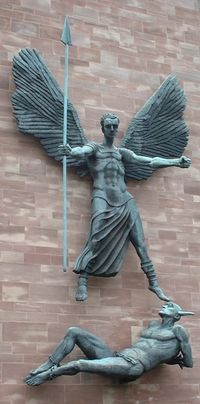
The Feast of St. Michael and All Angels

Luther Reed in The Lutheran Liturgy writes that the feast of St. Michael and All Angels commemorates the dedication, on a 29th of September sometime in the 5th century, of a small basilica on the Via Salaria, near Rome, the first church in Italy dedicated in honor of the Archangel Michael. In England Michaelmas is the traditional beginning of the Fall terms of courts and universities.

O everlasting God, who hast ordained and constituted the services of Angels and men in a wonderful order: Mercifully grant, that as thy holy Angels alway do thee service in heaven, so by thy appointment they may succor and defend us on earth; through Jesus Christ our Lord.

(The Book of Common Prayer [1662] of the Church of England)

Deus qui miro ordine angelorum ministeria hominumque dispensas: concede propitius vt a quibus tibi ministrantibus in caelo semper assistitur: ab his in terra vita nostra muniatur. Per dominum.
                Gregorian

Friday, July 23, 2010

A Christian's Death (?)

Today in Vadstena, Sweden, my friends in the Society of St. Birgitta have been celebrating her heavenly birthday with a High Mass, the prayer offices, a "formal lecture" by Archbishop Emil Paul Tscherrig (the Papal Nuncio to the Nordic lands) entitled The Reason for Christian Hope in a Joyful Future, and have concluded with their grand procession into the Vadstena Klosterkyrka (Abbey Church).

If I could afford to go to Sweden every summer, I'd be there for that and I expect that it, along with the entire week of the SSB's General Chapter, would have lifted my spirit from some of the angst of being in the ELCA these days. (Oh, well -- next year in Vadstena!).

All this as a way of introducing this reflection of death by Martin Luther that appeared as the fourth reading in For All the Saints for the Monday of the week of Pentecost 7 in year 2 (or a week ago Monday):
At birth a child comes forth amid pain and danger, from the narrow dwelling of the mother's womb, into the broad light of day. In a similar way a man goes through the narrow gate of death when he departs this life. And though heaven and earth under which we now live appear so wide, so vast, yet, in comparison with the heaven that shall be, it is far narrower and much smaller than is the womb in comparison with the broad expanse of heaven. That is why the death of saints is called a new birth, and their festivals birthdays.

A woman, when she is in travail, has sorrow, because her hour is come; but as soon as she is delivered of the child, she remembers no more the anguish for joy that a man is born into the world. Likewise in death. We wrestle in anguish, yet know that hereafter we shall come forth into a wide, open space, and into eternal joy.

When I feel the dread of death, I say, "O death, you have nothing to do with me, because I have another death which kills my death. And the death which kills is stronger than that which is killed."

God appointed death to be the destroyer of death. It is evidence for God's surpassing goodness, that after death has entered, [Gen. 3:19] it is not permitted to hurt us ultimately, but is taken captive at the outset, and made to be the punishment and death of sin.