Showing posts with label Society of the Holy Trinity. Show all posts

Friday, September 13, 2013

21 Years!!

Twenty-one years ago today, I was ordained into the Holy Ministry by Bishop J. Roger Anderson of the Southern California (West) Synod, ELCA. What follows is a slightly edited re-post of an entry I first posted five years ago, and have re-posted three and two years ago.
A blessed St. John Chrysostom's Day to you all. Zip+

+ + +
O Lord God, dear Father in heaven, I am indeed unworthy of the office and ministry in which I am to make known thy glory and to nurture and to serve this congregation.

But since thou hast appointed me to be a pastor and teacher, and the people are in need of the teaching and the instruction, O be thou my helper and let thy holy angels attend me.

Then if thou art pleased to accomplish anything through me, to thy glory and not to mine or to the praise of men, grant me, out of thy pure grace and mercy, a right understanding of thy Word and that I may also diligently perform it.

O Lord Jesus Christ, Son of the living God, thou shepherd and bishop of our souls, send thy Holy Spirit that he may work with me, yea, that he may work in me to will and to do through thy divine strength according to thy good pleasure. Amen!
I pray this, Luther's Sacristy Prayer, every Sunday as I vest for the Eucharist. I'll sometimes think then that it would be good to post it here again, and it is particularly fitting to do so today [thank you, Father Will, for the idea], for it was 21 years ago today that the Rt. Rev. J. Roger Anderson, first Bishop of the Southern California (West) Synod [now called the "Southwest California Synod"], of the Evangelical Lutheran Church in America addressed me as we stood in the Chancel of the Lutheran Church of the Resurrection (now called Faith Lutheran Church), Canoga Park, California, about 15 feet from where I had been baptized 33 years (less one week) earlier:
According to apostolic usage you are now to be set apart to the office of Word and Sacrament in the one holy catholic Church by the laying on of hands and by prayer.
Bishop Anderson was joined in the addresses that followed by the pastor loci and my pastor, the Rev. C. David Olsen (of blessed memory, who preached that afternoon), the Rev. Brian Eklund (pastor then at St. Mark's Lutheran Church, Los Angeles, who had supervised my seminary "Cross Cultural Experience"), and the Rev. Jeffrey Frohner (a friend and seminary classmate who had just begun serving his first call at Trinity Lutheran Church, Santa Barbara). With them standing around me, the Bishop then examined me:
Before almighty God, to whom you must give account, and in the presence of this congregation, I ask: Will you assume this office, believing that the Church's call is God's call to the ministry of Word and Sacrament?

I will, and I ask God to help me.

The Church in which you are to be ordained confeses that the Holy Scriptures are the Word of God and are the norm of its faith and life. We accept, teach, and confess the Apostles', the Nicene, and the Athanasian Creeds. We also acknowledge the Lutheran Confessions as true witnesses and faithful expositions of the Holy Scriptures. Will you therefore preach and teach in accordance with the Holy Scriptures and these creeds and confessions?

I will, and I ask God to help me.

Will you be diligent in your study of the Holy Scriptures and in your use of the means of grace? Will you pray for God's people, nourish them with the Word and Holy Sacraments, and lead them by your own example in faithful service and holy living?

I will, and I ask God to help me.

Will you give faithful witness in the world, that God's love may be know by all that you do?

I will, and I ask God to help me.

Almighty God, who has given you the will to do these things, graciously give you the strength and compassion to perform them.
After the Prayer of the Church and Come, Holy Ghost, they (though Brian and Jeffrey aren't really visible from this angle) were joined in the laying on of hands by the Rev. John Stump (of blessed memory; Pastor Olsen's predecessor and my pastor at Resurrection during most of my college years) and the 2 nearest neighboring ELCA pastors, the Rev. John Lundeen (then of St. Luke Lutheran Church, Woodland Hills, and whose father was the last President of the Augustana Lutheran Church) and the Rev. Bryan Woken (then and now at Shepherd of the Valley Lutheran Church, Canoga Park (West Hills). And thus they committed the Office of the Holy Ministry to me. Every time I attend an ordination, or simply take a few moments during devotions to review those promises -- many of us who have been in the Society of the Holy Trinity for a longer time have a card with them imprinted on the obverse of a holy card of Rublev's icon of the Old Testament Trinity -- I am struck once again by what I have been called to. How awsome! And how inadequate I am to bear that office.

Being reminded of that is a good thing. There is another similar Sacristy Prayer of Luther's that I don't use, but it always makes me smile. And then ponder:
Lord God, thou hast appointed me a bishop and pastor in thy church. Thou seest how unfit I am to undertake this great and difficult office, and were it not for thy help, I would long since have ruined it all. Therefore I cry unto thee; I will assuredly apply my mouth and my heart to thy service. I desire to teach the people and I myself would learn ever more and diligently meditate thy Word. Use thou me as thine instrument, only do not forsake me, for if I am left alone I shall easily bring it all to destruction. Amen.
What a glorious day it was 21 years ago. And in all I've done since, I've still not ruined it all. At least, not yet. ;)

What a gracious Lord God we have!

Monday, February 25, 2013

What I Am Learning on Retreat


Apologies to Waylon and Jessi....

Thursday, September 13, 2012

Twenty Years!

This is a slightly edited re-post of an entry I first posted five years ago, and have re-posted three and two years ago. A blessed St. John Chrysostom's Day to you all. Zip+
+ + +
O Lord God, dear Father in heaven, I am indeed unworthy of the office and ministry in which I am to make known thy glory and to nurture and to serve this congregation.

But since thou hast appointed me to be a pastor and teacher, and the people are in need of the teaching and the instruction, O be thou my helper and let thy holy angels attend me.

Then if thou art pleased to accomplish anything through me, to thy glory and not to mine or to the praise of men, grant me, out of thy pure grace and mercy, a right understanding of thy Word and that I may also diligently perform it.

O Lord Jesus Christ, Son of the living God, thou shepherd and bishop of our souls, send thy Holy Spirit that he may work with me, yea, that he may work in me to will and to do through thy divine strength according to thy good pleasure. Amen!
That is Luther's Sacristy Prayer, and I pray it every Sunday as I vest for the Eucharist. I'll sometimes think then that it would be good to post it here and it is particularly fitting to do so today (thank you, Father Weedon, for the idea), for it was 20 years ago today that the Rev. J. Roger Anderson , Bishop of what was then called the Southern California (West) Synod, Evangelical Lutheran Church in America addressed me as we stood in the Chancel of the Lutheran Church of the Resurrection (now called Faith Lutheran Church), Canoga Park, California, about 15 feet from where I had been baptized 33 years (less one week) earlier:
According to apostolic usage you are now to be set apart to the office of Word and Sacrament in the one holy catholic Church by the laying on of hands and by prayer.
Bishop Anderson was joined in the addresses that followed by the pastor loci and my pastor, the Rev. C. David Olsen (of blessed memory, who preached that afternoon), the Rev. Brian Eklund (pastor then at St. Mark's Lutheran Church, Los Angeles, who had supervised my seminary "Cross Cultural Experience"), and the Rev. Jeffrey Frohner (a friend and seminary classmate who had just begun serving his first call at Trinity Lutheran Church, Santa Barbara). With them standing around me, the Bishop then examined me:
Before almighty God, to whom you must give account, and in the presence of this congregation, I ask: Will you assume this office, believing that the Church's call is God's call to the ministry of Word and Sacrament?

I will, and I ask God to help me.

The Church in which you are to be ordained confeses that the Holy Scriptures are the Word of God and are the norm of its faith and life. We accept, teach, and confess the Apostles', the Nicene, and the Athanasian Creeds. We also acknowledge the Lutheran Confessions as true witnesses and faithful expositions of the Holy Scriptures. Will you therefore preach and teach in accordance with the Holy Scriptures and these creeds and confessions?

I will, and I ask God to help me.

Will you be diligent in your study of the Holy Scriptures and in your use of the means of grace? Will you pray for God's people, nourish them with the Word and Holy Sacraments, and lead them by your own example in faithful service and holy living?

I will, and I ask God to help me.

Will you give faithful witness in the world, that God's love may be know by all that you do?

I will, and I ask God to help me.

Almighty God, who has given you the will to do these things, graciously give you the strength and compassion to perform them.
After the Prayer of the Church and Come, Holy Ghost, they (though Brian and Jeffrey aren't really visible from this angle) were joined in the laying on of hands by the Rev. John Stump (of blessed memory; Pastor Olsen's predecessor and my pastor at Resurrection during most of my college years) and the 2 nearest neighboring ELCA pastors, the Rev. John Lundeen (then of St. Luke Lutheran Church, Woodland Hills, and one of the Augustana Synod's Lundeen clan) and the Rev. Bryan Woken (then and now at Shepherd of the Valley Lutheran Church, Canoga Park (West Hills). And thus they committed the Office of the Holy Ministry to me. Every time I attend an ordination, or simply take a few moments during devotions to review those promises -- many of us who have been in the Society of the Holy Trinity for a longer time have a card with them imprinted on the obverse of a holy card of Rublev's icon of the Old Testament Trinity -- I am struck once again by what I have been called to. How awsome! And how inadequate I am to bear that office.

Being reminded of that is a good thing. There is another similar Sacristy Prayer of Luther's that I don't use, but it always makes me smile, then ponder:
Lord God, thou hast appointed me a bishop and pastor in thy church. Thou seest how unfit I am to undertake this great and difficult office, and were it not for thy help, I would long since have ruined it all. Therefore I cry unto thee; I will assuredly apply my mouth and my heart to thy service. I desire to teach the people and I myself would learn ever more and diligently meditate thy Word. Use thou me as thine instrument, only do not forsake me, for if I am left alone I shall easily bring it all to destruction. Amen.
What an exciting day it was 20 years ago. And in all I've done since, I've not (yet) ruined it all. What a gracious Lord God we have!

Monday, September 13, 2010

Eighteen Years!

This is a slightly edited re-post of a previous blog entry. A blessed St. John Chrysostom's Day to you all. Zip+

+ + +
O Lord God, dear Father in heaven, I am indeed unworthy of the office and ministry in which I am to make known thy glory and to nurture and to serve this congregation.

But since thou hast appointed me to be a pastor and teacher, and the people are in need of the teaching and the instruction, O be thou my helper and let thy holy angels attend me.

Then if thou art pleased to accomplish anything through me, to thy glory and not to mine or to the praise of men, grant me, out of thy pure grace and mercy, a right understanding of thy Word and that I may also diligently perform it.

O Lord Jesus Christ, Son of the living God, thou shepherd and bishop of our souls, send thy Holy Spirit that he may work with me, yea, that he may work in me to will and to do through thy divine strength according to thy good pleasure. Amen!
That is Luther's Sacristy Prayer, and I pray it every Sunday as I vest for the Eucharist. I'll sometimes think then that it would be good to post it here and it is particularly fitting to do so today (thank you, Father Weedon, for the idea), for it was 18 years ago today that the Rev. J. Roger Anderson , Bishop of what was then called the Southern California (West) Synod, Evangelical Lutheran Church in America addressed me as we stood in the Chancel of the Lutheran Church of the Resurrection (now called Faith Lutheran Church), Canoga Park, California, about 15 feet from where I had been baptized 33 years (less one week) earlier:
According to apostolic usage you are now to be set apart to the office of Word and Sacrament in the one holy catholic Church by the laying on of hands and by prayer.
Bishop Anderson was joined in the addresses that followed by the pastor loci and my pastor, the Rev. C. David Olsen (of blessed memory, who preached that afternoon), the Rev. Brian Eklund (pastor then at St. Mark's Lutheran Church, Los Angeles, who had supervised my seminary "Cross Cultural Experience"), and the Rev. Jeffrey Frohner (a friend and seminary classmate who had just begun serving his first call at Trinity Lutheran Church, Santa Barbara). With them standing around me, the Bishop then examined me:
Before almighty God, to whom you must give account, and in the presence of this congregation, I ask: Will you assume this office, believing that the Church's call is God's call to the ministry of Word and Sacrament?

I will, and I ask God to help me.

The Church in which you are to be ordained confeses that the Holy Scriptures are the Word of God and are the norm of its faith and life. We accept, teach, and confess the Apostles', the Nicene, and the Athanasian Creeds. We also acknowledge the Lutheran Confessions as true witnesses and faithful expositions of the Holy Scriptures. Will you therefore preach and teach in accordance with the Holy Scriptures and these creeds and confessions?

I will, and I ask God to help me.

Will you be diligent in your study of the Holy Scriptures and in your use of the means of grace? Will you pray for God's people, nourish them with the Word and Holy Sacraments, and lead them by your own example in faithful service and holy living?

I will, and I ask God to help me.

Will you give faithful witness in the world, that God's love may be know by all that you do?

I will, and I ask God to help me.

Almighty God, who has given you the will to do these things, graciously give you the strength and compassion to perform them.
After the Prayer of the Church and Come, Holy Ghost, they (though Brian and Jeffrey aren't really visible from this angle) were joined in the laying on of hands by the Rev. John Stump (Pastor Olsen's predecessor and my pastor at Resurrection during most of my college years) and the 2 nearest neighboring ELCA pastors, the Rev. John Lundeen (then of St. Luke Lutheran Church, Woodland Hills, and one of the Augustana Synod's Lundeen clan) and the Rev. Bryan Woken (then and now at Shepherd of the Valley Lutheran Church, Canoga Park (West Hills). And thus they committed the Office of the Holy Ministry to me. Every time I attend an ordination, or simply take a few moments during devotions to review those promises -- many of us who have been in the Society of the Holy Trinity for a longer time have a card with them imprinted on the obverse of a holy card of Rublev's icon of the Old Testament Trinity -- I am struck once again by what I have been called to. How awsome! And how inadequate I am to bear that office.

Being reminded of that is a good thing. There is another similar Sacristy Prayer of Luther's that I don't use, but it always makes me smile, then ponder:
Lord God, thou hast appointed me a bishop and pastor in thy church. Thou seest how unfit I am to undertake this great and difficult office, and were it not for thy help, I would long since have ruined it all. Therefore I cry unto thee; I will assuredly apply my mouth and my heart to thy service. I desire to teach the people and I myself would learn ever more and diligently meditate thy Word. Use thou me as thine instrument, only do not forsake me, for if I am left alone I shall easily bring it all to destruction. Amen.
What an exciting day it was 18 years ago. And in all I've done since, I've not (yet) ruined it all. What a gracious Lord God we have!

Tuesday, March 16, 2010

The STS at Worship

I just learned about this video snip from the opening Eucharist at last Fall's General Retreat of the Society of the Holy Trinity that's been on YouTube. The setting is the Chapel at the University of St. Mary of the Lake/Mundelein Seminary for the Feast of St. Michael and All Saints 2009 as we are singing the grand hymn, "Ye Watchers and Ye Holy Ones".


In case you're wondering, you can see me in my alb (I'm the Thurifer) standing near the Processional Cross which is to the the right-side (from the viewer's perspective) of the Altar.

Sunday, September 13, 2009

Seventeen Years

What follows is a slightly edited re-post a previous blog post. A blessed St. John Chrysostom's Day to you all. Zip+

+ + +
O Lord God, dear Father in heaven, I am indeed unworthy of the office and ministry in which I am to make known thy glory and to nurture and to serve this congregation.

But since thou hast appointed me to be a pastor and teacher, and the people are in need of the teaching and the instruction, O be thou my helper and let thy holy angels attend me.

Then if thou art pleased to accomplish anything through me, to thy glory and not to mine or to the praise of men, grant me, out of thy pure grace and mercy, a right understanding of thy Word and that I may also diligently perform it.

O Lord Jesus Christ, Son of the living God, thou shepherd and bishop of our souls, send thy Holy Spirit that he may work with me, yea, that he may work in me to will and to do through thy divine strength according to thy good pleasure. Amen!
That is Luther's Sacristy Prayer, and I pray it every Sunday as I vest for the Eucharist. I'll sometimes think then that it would be good to post it here and it is particularly fitting to do so today (thank you, Father Weedon, for the idea), for it was 17 years ago today that the Rev. J. Roger Anderson, Bishop of what was then called the Southern California (West) Synod, Evangelical Lutheran Church in America addressed me as we stood in the Chancel of the Lutheran Church of the Resurrection, Canoga Park, California, about 15 feet from where I had been baptized 33 years (less one week) earlier:
According to apostolic usage you are now to be set apart to the office of Word and Sacrament in the one holy catholic Church by the laying on of hands and by prayer.
Bishop Anderson was joined in the addresses that followed by the pastor loci and my pastor, the Rev. C. David Olsen (of blessed memory, who preached that afternoon), the Rev. Brian Eklund (pastor then at St. Mark's Lutheran Church, Los Angeles, who had supervised my seminary "Cross Cultural Experience"), and the Rev. Jeffrey Frohner (a friend and seminary classmate who had just begun serving his first call at Trinity Lutheran Church, Santa Barbara). With them standing around me, the Bishop then examined me:
Before almighty God, to whom you must give account, and in the presence of this congregation, I ask: Will you assume this office, believing that the Church's call is God's call to the ministry of Word and Sacrament?

I will, and I ask God to help me.

The Church in which you are to be ordained confeses that the Holy Scriptures are the Word of God and are the norm of its faith and life. We accept, teach, and confess the Apostles', the Nicene, and the Athanasian Creeds. We also acknowledge the Lutheran Confessions as true witnesses and faithful expositions of the Holy Scriptures. Will you therefore preach and teach in accordance with the Holy Scriptures and these creeds and confessions?

I will, and I ask God to help me.

Will you be diligent in your study of the Holy Scriptures and in your use of the means of grace? Will you pray for God's people, nourish them with the Word and Holy Sacraments, and lead them by your own example in faithful service and holy living?

I will, and I ask God to help me.

Will you give faithful witness in the world, that God's love may be know by all that you do?

I will, and I ask God to help me.

Almighty God, who has given you the will to do these things, graciously give you the strength and compassion to perform them.
After the Prayer of the Church and Come, Holy Ghost, they (though Brian and Jeffrey aren't really visible from this angle) were joined in the laying on of hands by the Rev. John Stump (Pastor Olsen's predecessor and my pastor at Resurrection during most of my college years) and the 2 nearest neighboring ELCA pastors, the Rev. John Lundeen (then of St. Luke Lutheran Church, Woodland Hills, and one of the Augustana Synod's Lundeen clan) and the Rev. Bryan Woken (then and now at Shepherd of the Valley Lutheran Church, Canoga Park (West Hills). And thus they committed the Office of the Holy Ministry to me. Every time I attend an ordination, or simply take a few moments during devotions to review those promises -- many of us who have been in the Society of the Holy Trinity for a longer time have a card with them imprinted on the obverse of a holy card of Rublev's icon of the Old Testament Trinity -- I am struck once again by what I have been called to. How awsome! And how inadequate I am to bear that office.

Being reminded of that is a good thing. There is another similar Sacristy Prayer of Luther's that I don't use, but it always makes me smile, then ponder:
Lord God, thou hast appointed me a bishop and pastor in thy church. Thou seest how unfit I am to undertake this great and difficult office, and were it not for thy help, I would long since have ruined it all. Therefore I cry unto thee; I will assuredly apply my mouth and my heart to thy service. I desire to teach the people and I myself would learn ever more and diligently meditate thy Word. Use thou me as thine instrument, only do not forsake me, for if I am left alone I shall easily bring it all to destruction. Amen.
What an exciting day it was 17 years ago. And despite all I've done since, somehow it's not yet been destroyed. What a gracious Lord God we have!

Wednesday, February 27, 2008

Requiescat in pace:
+William H. Lazareth, STS

The initial announcement on Monday morning was brief:
Dean Rodney Eberhardt of the Metro New York Chapter has informed me that the Most Rev. William H. Lazareth, STS, departed this earthly life at 12:10 PM on Saturday February 23, 2008. A private funeral will be held in Bar Harbor, Maine for the family. The current plans are to hold a memorial sevice (date to be determined) in Eastertide to be held at St Matthew's Lutheran Church, White Plains, NY. When the date and further information is available, the information will be given to Bishop Lazareth's fellow members in the Society.

Blessed are the dead who die in the Lord + Yea, for they rest from their labors.

Frank C. Senn, STS,
Senior
We have lost a giant in the Faith.

You can read a the obituaries from Carthage College and the ELCA News Service. They refer to much of his career as a seminary professor at Mt. Airy, author, parish pastor, world-renowned theologian (particularly for his work with the Faith and Order Commission of the World Council of Churches, the first Bishop of the ELCA's Metropolitan New York Synod, and still a teacher in "retirement."

None of the obituaries have yet mentioned that Bishop Lazareth was one of the early subscribers to the Rule of the Society of the Holy Trinity, one of two retired ELCA Bishops (now both departed from this life) to do so. He participated as he was able in the STS Metro New York and Wisconsin Chapters and by occasionally representing the Society while addressing theological conferences.

I first knew of Dr. Lazareth some 30 years ago (ouch!) when I was a young layman in the Lutheran Church of America, while he headed theDepartment for Church in Society, Division for Mission in North America, and you'll find some of his work in my library, both books and LCA studies. I was privileged to meet him a couple of times, in 1993 when he was one of the Hein-Fry lecturers and in 2004 when he was one of the STS speakers at a Colloquium on the Ministry sponsored by the Society and Concordia Theological Seminary, Fort Wayne entitled “The Lutheran Ministry in Light of the Great Tradition.”

Bishop William H. Lazareth, STS, churchman (1928-2008). There are few like him left in the ELCA. Much to our loss.

    In paradisum deducant te angeli:
    in tuo adventu suscipiant te martyres
    et perducant te in civitatem sanctam Jerusalem.
    Chorus angelorum te suscipiat,
    et cum Lazaro quondam paupere aeternam habeas requiem.

Thursday, September 13, 2007

Fifteen Years, Today

O Lord God, dear Father in heaven, I am indeed unworthy of the office and ministry in which I am to make known thy glory and to nurture and to serve this congregation.

But since thou hast appointed me to be a pastor and teacher, and the people are in need of the teaching and the instruction, O be thou my helper and let thy holy angels attend me.

Then if thou art pleased to accomplish anything through me, to thy glory and not to mine or to the praise of men, grant me, out of thy pure grace and mercy, a right understanding of thy Word and that I may also diligently perform it.

O Lord Jesus Christ, Son of the living God, thou shepherd and bishop of our souls, send thy Holy Spirit that he may work with me, yea, that he may work in me to will and to do through thy divine strength according to thy good pleasure. Amen!
That is Luther's Sacristy Prayer, and I pray it every Sunday as I vest for the Divine Service. I'll sometimes think then that it would be good to post it here and it is particularly fitting to do so today (thank you, Pastor Weedon, for the idea), for it was 15 years ago today that the Rev. J. Roger Anderson, Bishop of the Southern California (West) Synod, Evangelical Lutheran Church in America addressed me as we stood in the Chancel of the Lutheran Church of the Resurrection, Canoga Park, California, about 15 feet from where I had been baptized 33 years (less one week) earlier:
According to apostolic usage you are now to be set apart to the office of Word and Sacrament in the one holy catholic Church by the laying on of hands and by prayer.
Bishop Anderson was joined in the addresses that followed by the pastor loci and my pastor, the Rev. C. David Olsen (of blessed memory, who preached that afternoon), the Rev. Brian Eklund (pastor then and now at St. Mark's Lutheran Church, Los Angeles, who had supervised my seminary "Cross Cultural Experience"), and the Rev. Jeffrey Frohner (a friend and seminary classmate who had just begun serving his first call at Trinity Lutheran Church, Santa Barbara). With them standing around me, the Bishop then examined me:
Before almighty God, to whom you must give account, and in the presence of this congregation, I ask: Will you assume this office, believing that the Church's call is God's call to the ministry of Word and Sacrament?

I will, and I ask God to help me.

The Church in which you are to be ordained confeses that the Holy Scriptures are the Word of God and are the norm of its faith and life. We accept, teach, and confess the Apostles', the Nicene, and the Athanasian Creeds. We also acknowledge the Lutheran Confessions as true witnesses and faithful expositions of the Holy Scriptures. Will you therefore preach and teach in accordance with the Holy Scriptures and these creeds and confessions?

I will, and I ask God to help me.

Will you be diligent in your study of the Holy Scriptures and in your use of the means of grace? Will you pray for God's people, nourish them with the Word and Holy Sacraments, and lead them by your own example in faithful service and holy living?

I will, and I ask God to help me.

Will you give faithful witness in the world, that God's love may be know by all that you do?

I will, and I ask God to help me.

Almighty God, who has given you the will to do these things, graciously give you the strength and compassion to perform them.
After the Prayer of the Church and Come, Holy Ghost, they (though Brian and Jeff aren't really visible from this angle) were joined in the laying on of hands by the Rev. John Stump (Pastor Olsen's predecessor and my pastor at Resurrection during most of my college years) and the 2 nearest neighboring ELCA pastors, the Rev. John Lundeen (then of St. Luke Lutheran Church, Woodland Hills, and one of the Augustana Synod's Lundeen clan) and the Rev. Bryan Woken (then and now at Shepherd of the Valley Lutheran Church, Canoga Park (West Hills). And thus they committed the Office of the Holy Ministry to me. Every time I attend an ordination, or simply take a few moments during devotions to review those promises -- many of us who have been in the Society of the Holy Trinity for a longer time have a card with them imprinted on the obverse of a holy card of Rublev's icon of the Old Testament Trinity -- I am struck once again by what I have been called to. How awesome! And how inadequate I am to bear that office.

Being reminded of that is a good thing. There is another similar Sacristy Prayer of Luther's that I don't use, but it always makes me smile, then ponder:
Lord God, thou hast appointed me a bishop and pastor in thy church. Thou seest how unfit I am to undertake this great and difficult office, and were it not for thy help, I would long since have ruined it all. Therefore I cry unto thee; I will assuredly apply my mouth and my heart to thy service. I desire to teach the people and I myself would learn ever more and diligently meditate thy Word. Use thou me as thine instrument, only do not forsake me, for if I am left alone I shall easily bring it all to destruction. Amen.
What an exciting day it was 15 years ago. And despite all I've done since, somehow it's not yet been destroyed. What a gracious Lord God we have!

Monday, May 14, 2007

The 9.5 Theses

The disputes one finds today in the ELCA are nothing new for us. In Lent of 1995 a group of pastors sent to every ELCA pastor what they called 9.5 Theses Concerning the Confession of the Faith in the Evangelical Lutheran Church in America. Over 700 ELCA pastors signed them, but the hoped-for discussion was quashed from the ELCA's highest levels. I'll confess that I never got around to signing them, but from these 9.5 Theses emerged the Society of the Holy Trinity, whose Rule I subscribed to at the first opportunity.

As a participant in several venues in the continuing debates that rage over the Scriptures, the Ministry, worship (both liturgical language and styles), marriage and sexuality, etc. in the ELCA (and other churches), I find that the 9.5 Theses continue to speak a powerful, even prophetic, word to us. And far more eloquently than much of our discourse today. I commend them to you.


9.5 Theses
Concerning the Confession of the Faith
in the Evangelical Lutheran Church in America

Preamble

To the people of the Evangelical Lutheran Church in America, "who have been chosen and destined by God the Father and sanctified by the Spirit to be obedient to Jesus Christ and to be sprinkled with his blood," and to their pastors: "May grace and peace be yours in abundance" (1 Peter 1:2).

The ELCA is in a crisis—a crisis of faith. The critical question is whether this church will prove faithful to the prophetic and apostolic Scriptures and the catholic creeds and evangelical confessions, or fall into apostasy—a fall which could go either to the right or to the left. Many in the ELCA tilt toward the right—the ideologies of enthusiasm, fundamentalism, nationalism, and pietism. Many others lean toward the left—the ideologies of activism, feminism, advocacy. This results in the appearance of a conservative versus liberal struggle, but this appearance is an illusion. The real struggle is for faithful adherence to the Scriptures, creeds and confessions over against their subordination to these social or religious ideologies.

Whenever such ideologies prevail, the Word of God is silenced among us and driven out of the Church, and our people, left to their own devices, are deprived of that true consolation which comes from "the Gospel of God . . . concerning his Son . . . Jesus Christ our Lord" (Romans 1:1ff).

Praying for the Church, rejoicing in the Gospel, convicted by the Word of God, we offer the following theses, that our confession of the Faith might address the current crisis directly and honestly. Our pastoral office compels us to speak.

1. The Revelation and Name of the Holy Trinity

"When the Advocate comes, whom I will send to you from the Father, the Spirit of truth who comes from the Father, he will testify on my behalf." (John 15:26)

"Throughout the world the holy Church acclaims, praises, worships" no other God than the LORD God of Israel, revealed in and named by Jesus Christ as "the Father, and the Son and the Holy Spirit" (Te Deum; Matthew 28:19; Augsburg Confession—Article I).

We reject the false teaching that the naming of God as Father is a human construct to be understood on the analogy of human fatherhood; that it designates Israel's God as male; that the Trinitarian Name of Father, Son and Holy Spirit is inherently oppressive to human beings in general or women in particular; or that substituting triadic terms is adequate.

The Word of God is silenced among us and driven out of the Church whenever the Name of the Father and the Son and the Holy Spirit is ignored, minimized, marginalized, suppressed or altered in the Church's preaching and praying, baptizing and confessing.

2. The Bondage of Humanity to Sin

"Therefore, just as sin came into the world through one man, and death came through sin, and so death spread to all because all have sinned." (Romans 5:12)

The Church confesses "that we are in bondage to sin and cannot free ourselves" (Lutheran Book of Worship—Brief Order for Confession and Forgiveness; Augsburg Confession—Articles II, XVIII, XIX).

We reject the false teaching that would place ultimate hope in human goodness and self-fulfillment, that would confuse sin with failure or lack of virtue, that would exchange confession of our sin before God for self-analyses of perceived human problems.

The Word of God is silenced among us and driven out of the Church whenever we sinners are not held accountable before the holy and righteous God.

3. The Person and Work of God the Son

"Without any doubt, the mystery of our religion is great: He was revealed in the flesh, vindicated by the Spirit, seen by angels, preached among Gentiles, believed in throughout the world, taken up in glory." (1 Timothy 3:16)

The Church confesses and believes in Jesus Christ, the incarnate Word of God, "the eternal Son of the Father," crucified and raised for the salvation of the world, "worthy of all worship" (Te Deum; Augsburg Confession—Article III).

We reject the false teaching that would separate the man Jesus from the risen Christ, and diminish his particular identity by "re-imagining" him as female, speaking of him as androgynous, or using him as a "Christ-principle." We also reject the false teaching that Christ is for Christians only, that he is but one savior among many, that faith is salutary apart from the particular work of Christ.

The Word of God is silenced among us and driven out of the Church whenever, under the guise of a false pluralism, we do not boldly proclaim the man Jesus Christ, the Jew from Nazareth, as the unique and universal Savior, the One for the many.

4. The Proclamation of Forgiveness, Life and Salvation

"For by grace you have been saved through faith, and this is not your own doing; it is the gift of God." (Ephesians 2:8)

The Church "acknowledges one Baptism for the forgiveness of sins," in which God has justified the ungodly and promised salvation from sin and death, from devil and hell, and from God's own law and wrath, "and opened the kingdom of heaven to all believers" (Nicene Creed; Te Deum; Augsburg Confession—Articles III & IV).

We reject the false teaching that would replace God's eschatological salvation with therapeutic rejuvenation, material well-being, social transformation, the spread of provisional human justice, or other good and desirable effects in what unbelief would label "the real world."

The Word of God is silenced among us and driven out of the Church when the singular and specific promise of  the Gospel is traded for the promise of some worldly good or the plans and pleas for human betterment.

5. The Holy Spirit and the Means of Grace

"So faith comes from what is heard, and what is heard comes through the word of Christ." (Romans 10:17)

The Church confesses and believes in "the Holy Spirit, Advocate and Guide," who "calls, gathers, enlightens, and sanctifies the whole Christian Church" through, and only through, God's means of Grace, which is the preaching of the Word—i.e. through Scripture, sermon, Baptism, Absolution, and Communion (Te Deum; Small Catechism—Creed—Article III; Augsburg Confession—Articles V, IX-XIII).

We reject the false teaching that the Holy Spirit is given apart from the preached Word and sacraments, that the Holy Spirit is evidenced by human enthusiasm or activism, that the Holy Spirit is to be equated with the dynamic of social, political and spiritual movements. We reject the false teaching that the Church grows through human ingenuity and energy. We reject the false teaching that God's liturgy is a tool for the advancement of political, cultural or therapeutic programs. We reject the elevation of organizational success, growth in numbers, and political and therapeutic activity to the status of marks of the Church.

The Word of God is silenced among  us and driven out of the Church when the true means of grace "the preaching of the Word and the sacraments" no longer
defines, structures and centers the ministry and mission of the Christian congregation.

6. The Vocation of the Baptized and Good Works

"For we are what he has made us, created in Christ Jesus for good works, which God prepared beforehand, to be our way of life." (Ephesians 2:10)

The Church confesses that the faithful are "bound to bring forth fruits—that is, the good works mandated by God" in the Ten Commandments, and done for God's sake alone (Augsburg Confession—Articles VI, XVI, XX).

We reject the false teaching that would elevate advocacy for self-chosen high-visibility causes above the common participation of Christians in the life of the world as husbands and wives, mothers and fathers, employers, workers, artists, teachers, doctors, lawyers, politicians, etc.

The Word of God is silenced among us and driven out of the Church whenever the daily vocation of Christians is denigrated.

7. The Unity of the Church Catholic

"For in the one Spirit we were all baptized into one body—Jews or Greeks, slaves or free—and we were all made to drink of one Spirit." (1 Corinthians 12:13)

The Church "believes in one holy catholic and apostolic Church," "the Body of Christ," which is the congregation of the faithful gathered by the Holy Spirit to hear the preached Word and sacraments (Nicene Creed; Romans 12:5; I Corinthians 12:12ff.; Augsburg Confession—Article Vll).

We reject the false teaching of a North American liberal Christianity that would substitute a politically-devised multi-culturalism or inclusivism for the Church's true catholic unity in the preached Word and sacraments. We reject the false teaching of a North American conservative Protestantism that would substitute an invisible, spiritual experience of fellowship for the concrete reality of the preached Word and sacraments.

The Word of God is silenced among us and driven out of the Church whenever the visible unity of the churches is not actively pursued in terms of the true God-given unity of the Church in Word and Sacrament.

8. The Proper Distinction between Law and Gospel

"For 'no human being will be justified in his sight' by deeds prescribed by the law, for through the law, comes the knowledge of sin." (Romans 3:20)

The Church teaches that both law and gospel must continually be preached in the congregation of the faithful: the law to convict people of sin and to promote God's temporal justice, the gospel to forgive people of sins and to Proclaim God's eternal righteousness (Apology of Augsburg Confession—Article IV).

We reject the false teaching that would identify God's law with achievable human goals rather than as the call to repent from sin and to amend one's life before the holy God. We reject the false teaching that would re-define God's gospel as a freedom which allows individuals to fulfill themselves and to do whatever pleases them.

The Word of God is silenced among us  and driven out of the Church whenever it is no longer held that God Almighty who created everything and gave us his law is the one God who redeemed the creation and renews it through his Holy Spirit.

9. The Holy Ministry

"Think of us in this way, as servants of Christ and stewards of God's mysteries." (1 Corinthians 4:1)

The Church teaches that the holy Ministry is the divinely instituted public office of  preaching the Word and sacraments in the congregation of the faithful (Augsburg Confession—Articles V, XIV, XXVIII; cf. Occasional Services—Ordination).

We reject the false teaching that would define the holy Ministry as a "helping profession," and so turn bishops and pastors into psychological counselors or social activists. We reject the false teaching that would fragment the one divinely instituted Ministry into so-called specialized ministries, as if the circumstances of ministry determine its content and practice. We reject the false teaching that ordained ministers are not subject to an exemplary standard in their conduct and relationships, or that they may excuse immoral behavior by an appeal to privacy or gospel freedom.

The Word of God is silenced among us and driven out of the Church whenever the holy Ministry becomes a loosely defined service to people rather than the specific divine call to serve the Word of God, and whenever bishops and pastors are not encouraged to adorn the holy Ministry with holy lives.

9.5.

"We believe that you will come and be our judge. Come, then, Lord, and help your people, bought with the price of your own blood, and bring us with your saints to glory everlasting." (Te Deum)

Almighty God, grant to your Church your Holy Spirit and the wisdom which comes down from heaven, that your Word may not be bound but have free course and be preached to the joy and edifying of Christ's holy people, that in steadfast faith we may serve you and in the confession of your name may abide to the end, through Jesus Christ our Lord. Amen. (Lutheran Book of Worship—Matins & Vespers)

Signed:
          Pastor Louis A. Smith, Collingswood, NJ
          Pastor Phillip Max Johnson, Jersey City, NJ
          Pastor Linda Sue Larson, Cresskill, NJ
          Pastor John David Larson, Cresskill, NJ
          Pastor Richard F. Niebanck, Delhi, NY
          Pastor Beth A. Schlegel, Trenton, NJ
          Pastor Mark A. Hoffman, Moorestown, NJ


For other copies of the 9.5 Theses on the web, see here (this includes the cover letter), here, here, and here.

Each of the above signing pastors were among the founders of the Society of the Holy Trinity in 1997. Lou Smith was the Society's Vicar when he departed from this life in November 2004. Phillip Johnson, our first Senior, was received into the Catholic Church last summer. The others still hold the fort in the ELCA.

Monday, October 09, 2006

Jesus' Inspriational T-shirt

Listen to (okay, read) Pastor Karl Johnsen, STS, preaching the first Vespers sermon at the General Retreat of the Society of the Holy Trinity. The texts that Tuesday evening were Job 12:1; 13:3-17, 21-27 and St. John 8:33-47:
I have been known at times to frequent certain Christian bookstores of the sort with which I am sure most of you are familiar. You know the ones. The place where you can buy everything from "God's Gym" and "This Blood's for You" T-Shirts, to the latest installment in the ubiquitous Prayer of Jabez franchise. And of course, let us not forget, right up there by the checkout, the ever popular "Testa-Mints". The breath freshener with a message to share.

Somewhere in that same store you are bound to find any number of wall plaques, posters, calendars, and coffee mugs, each bearing some inspirational message straight from the mouth of our Lord. You know the ones; "I am the bread of Life", "I am the light of the world", "Behold I stand at the door and knock". But it strikes me that I have never seen an inspirational poster, coffee mug, calendar, or T-shirt quoting our Lord's words in today's gospel text where he says "You are of your Father the Devil, and your will is to do your Father's desires." (John 8:44a) I guess this is not surprising. When looking for something to put on an inspirational poster, we tend to gravitate toward something more, ... well ..., inspirational. Something more comforting than convicting.

At the end of the day however, we ought not to worry overmuch about what brothers and sisters in other Christian denominations do or do not put on inspirational posters and T-shirts. But perhaps we would do well to worry that we might just be tempted downplay or even ignore words such as these in our ministry of preaching and teaching. They are after all, uncomfortable words, and we like to see ourselves as being in the business of comforting people.

Therefore, perhaps we might be tempted to ignore them, or to relegate them to some sort of secondary status on the grounds that they do not "drive Christ" as well as does a passage like Romans chapter 8. But the mental gymnastics required to contend that the words of St. Paul drive Christ more effectively than the words of Jesus himself is just a bit beyond my ability to bear.

Or, we may choose to interpret these words very narrowly, solely within the context of Jesus' conversation with those particular people, in that particular place, at that particular time. But it strikes me that perhaps we are overly quick to do this. Especially when you consider how quick we are to interpret a more comforting passage such as Jesus' gracious words of forgiveness to the woman caught in adultery in the more universal sense, that is, as being true for all of us, and not just for that woman, in that place, and at that time.

Perhaps there is some benefit in letting Jesus' hard words stand and accuse us, in all of their stark and dark simplicity.

So, let me try this T-shirt on for size:
    "I am of my father the devil, and my will is to do my father's desires."
But immediately, I begin to protest. "Am I really all that bad? Doesn't this sound just a bit too judgmental? Surely I do not deserve God's wrath, if indeed such a thing still exists in these enlightened times. Soon I find myself taking the position of Job, protesting my innocence. Soon I, like Job, am desiring to speak to the Almighty, and to argue my case with God.
Read it all here on the Society's web site.

Friday, October 06, 2006

The Angels (cont'd)

From the Society of the Holy Trinity's General Retreat

The sermon for Michaelmas proclaimed by Pr. Pari Bailey, STS, at the Society of the Holy Trinity's General Retreat that I mentioned a few days ago is now posted on the Society's website.
We've got angels. Boy, do we. There are angels of the month, birthstone angels, dashboard charms that say, "Never drive faster than your guardian angel can fly." Bumper stickers that proclaim, "Angels on board." There are gardening angels, Mother's Day angels, Hallmark angels holding everything from Thanksgiving turkeys to St. Patrick's Day shamrocks.

Fat blonde babies with wings cavort on every possible item. Chubby cherubs, swathed in Victorian chintz drapery, halos charmingly askew, look more like spun-sugar dumplings than anything that would cry, "Holy, holy, holy is the Lord God, the Almighty!" Greeting cards, wallpaper, candy bars, movies like "Angels in America"— feathered wings joined with human fallibilities are just everywhere these days!

But then there's this:
    Rank on rank the host of heaven spreads its vanguard on the way
    As the Lord of light descending from the realms of endless day
    Comes, the pow'rs of hell to vanquish
    As the darkness clears away.
Set them side by side, the post-modern depiction of angels as a pleasant remnant of myth, made in our image, bent to our will, filling desire for spirituality and a crass marketing niche all at once —and then the Scriptural image of the vanguard of the army of heaven, the praises of God in their throats and a two-edged sword in their hands, a choir in battle formation, with captains and princes, standards and banners arrayed around the throne of the Lord of Light.

Singers with shields, messengers, bringers of the divine Word, some appointed to ceaseless praise, some appointed to help us on earth: these are the angels of the Lord.

The cosmology of the ancient world is not ours—or so we think. We no longer see angels behind every physical force of nature, every unexplained scientific phenomenon. Except for the Left Behind crowd and the devotees of Frank Peretti and those who tend to see the world in terms of Star Wars, anyway—most Christians, and certainly most Lutherans, don't describe our reality with reference to a cosmic battleground between the evenly-matched forces of good and evil. We already know what battle standard the Host of heaven carries, what device is blazoned on every shield and breastplate, in what sign they conquer.

Whether our modern sensibilities accept it or not, the holy angels are not incidental to, or independent from, the salvation and the power and the kingdom of our God and the authority of his Christ. In the might of the Messiah and under the banner of the cross, the host of heaven continues to do God's will and bring his Word despite the death throes of the dragon. The war is over, Satan is finished. Cast down. But still he fights on, mortally wounded, utterly defeated. His time is short.
For the entire sermon, click on this page or on the STS site the link for the St. Michael's Day Sermon.

And the Catholic Church became "Lutheran"

In his opening address at last week's General Retreat of the Society of the Holy Trinity, the Rev. Dr. Frank C. Senn, Senior of the STS and pastor at Immanuel Lutheran Church, Evanston, Illinois, first took us back to the Reformation and the 16th Century:
In that confessional hardening, the Western Catholic Church split into competing confessions that were encoded into law. We today are not only the heirs of Martin Luther's reform movement; we are also the heirs of the lex reformandi. When the Lutheran Confession of Augsburg was adopted in cities and lands by vote of city councils and by order of princes, church and society had to be reformed in the light of this Confession. That meant that laws or ordinances had to be drawn up and enacted. There's nothing unusual about this. A reform that fails to attain legal status and to be incarnated in institutions will fail. It will remain just a good idea. But if it is encoded in law, a reform can change people's behavior and even their thinking, no matter how much they may at first begrudge the change. Through law -- church ordinances -- and official teaching on a popular level-catechisms-Lutheranism became the confessional reality of the Catholic Church in some places across central and northern Europe. Church life went on, but with significant changes that were inculcated into the hearts and minds of the people through consistent preaching and teaching and new patterns of worship.

In most places implementing these reforms required a break with the local hierarchy and therefore also a break in communion with the bishop of Rome. But Lutherans did not think they were breaking with the catholic tradition. They asserted twice in their Confession -- once after the twenty-one doctrinal articles and again after the seven pastoral articles -- that their churches had not departed, in their teachings and practices, from the Catholic Church, or even the Church of Rome, insofar as that is known from its ancient writers. Insofar as they were returning to the clear testimonies of Scripture and the church fathers, they implied that the Church under the pope had departed from this tradition. Later on the second Martin, Martin Chemnitz, would examine the Council of Trent and conclude that the Council had proposed a new understanding of tradition that was a novelty in Christian history.
Later in his address, Pr. Senn then brought us into the contemporary era, both throwing down and taking up the ecumenical gauntlet:
If Pope Benedict XVI, who was so instrumental in working out the final details of the Joint Declaration on the Doctrine of Justification, wants to strike a blow for Lutheran-Roman Catholic rapprochement, let him lift the papal bull of Leo X, Exsurge Domine, and declare that Martin Luther is not a heretic. In 1958, Father Joseph Ratzinger addressed a pastoral council in Vienna with these words:
There is no appropriate category in Catholic thought for the phenomenon of Protestantism today (one could say the same of the separated Churches of the East). It is obvious that the old category of "heresy" is no longer of any value. Heresy, for scripture and the early church, includes the idea of a personal decision against the unity of the church, and heresy's characteristic is pertinacia, the obstinacy of one who persists in his or her own private way. This, however, cannot be regarded as an appropriate description of the spiritual situation of the Protestant Christian. In the course of a now-centuries old history, Protestantism had made an important contribution to the realization of Christian faith, fulfilling a positive development of the Christian message and, above all, often giving rise to a sincere and profound faith in the individual non-Catholic Christian, whose separation from the Catholic affirmation has nothing to do with the pertinacia of heresy.... We must try to think our way forward here in the spirit of the New Testament and to apply this spirit to all the things that did not exist then, but are in our world today.

If this still represents the mind of Pope Benedict XVI, then we are grateful that we cannot be regarded as heretics. But can Martin Luther still be regarded as a heretic? He issued his call for reform as a loyal son of the Church. He had widespread support among the clergy and people. His proposals were never dealt with in a free council bringing all theological parties together. If "Protestantism has made an important contribution to the realization of Christian faith," Martin Luther had a lot to do with that. Pope Benedict XVI's admiration for the reformer is well known. Let him advance rapprochement to the next step by rescinding Exsurge Domine.

And on our part, let Lutheran Churches declare that the pope is not the Anti-Christ, turn to him for authoritative teaching in matters of faith and morals, and expect his leadership in the pursuit of Christian unity.

In the meantime, we members of the Society of the Holy Trinity are pastors in Lutheran Churches. According to our Rule, we are committed to the reconciliation of Lutheran Churches with the bishop and Church of Rome. It is not up to us to say what this reconciliation will look like, although we can use our ecumenically-informed imaginations. What we can do is move our Churches closer to the Roman Church by moving them closer to our own confessions, which include the three ecumenical creeds. There are many ways in which our Lutheran Churches have drifted away from their confessional moorings. I need not count them here; our Founding Statement gives such an accounting, and it is worth revisiting that document from time to time. But this Society exists primarily "to work toward the confessional and spiritual renewal of Lutheran churches." It is for that purpose that this ministerium has been formed and convenes in retreats. We will contribute to the renewal of Lutheran Churches by being ourselves renewed in our ordination vows, following the discipline laid out in the Rule of this Society.
There's more and you can read it all here.

Saturday, September 30, 2006

The Angels


The day that has just past was the festival of St. Michael and All Angels (aka Michaelmas). We celebrated the festival a day early at the closing Eucharist for the STS General Retreat, where Pr. Pari Bailey, STS, preached about the place angels in our culture and in the Christian Faith. I will soon post a copy of that sermon on the STS website, but until then I suggest that you check out The Confessing Reader where you will find -- as you will for nearly every Christian festival that included in the Calendar of the Book of Common Prayer -- a good and faithful description of angels in the Holy Scriptures and Christian tradition.

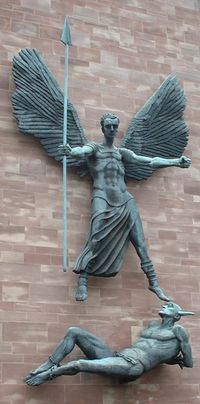
As the depiction here (taken shamelessly from The Confessing Reader's blog entry) of St. Michael suggests, the angels of God are not the harmless, cute beings in the "angels" section of gift shops, on greeting cards, or in popular American culture. I daresay that images of angels you might find in your local "Christian" bookstore or in a church's children's pageant won't be in line with this photo, either. But ponder upon the first words so often spoken by an angel in the Bible: "Do not be afraid."